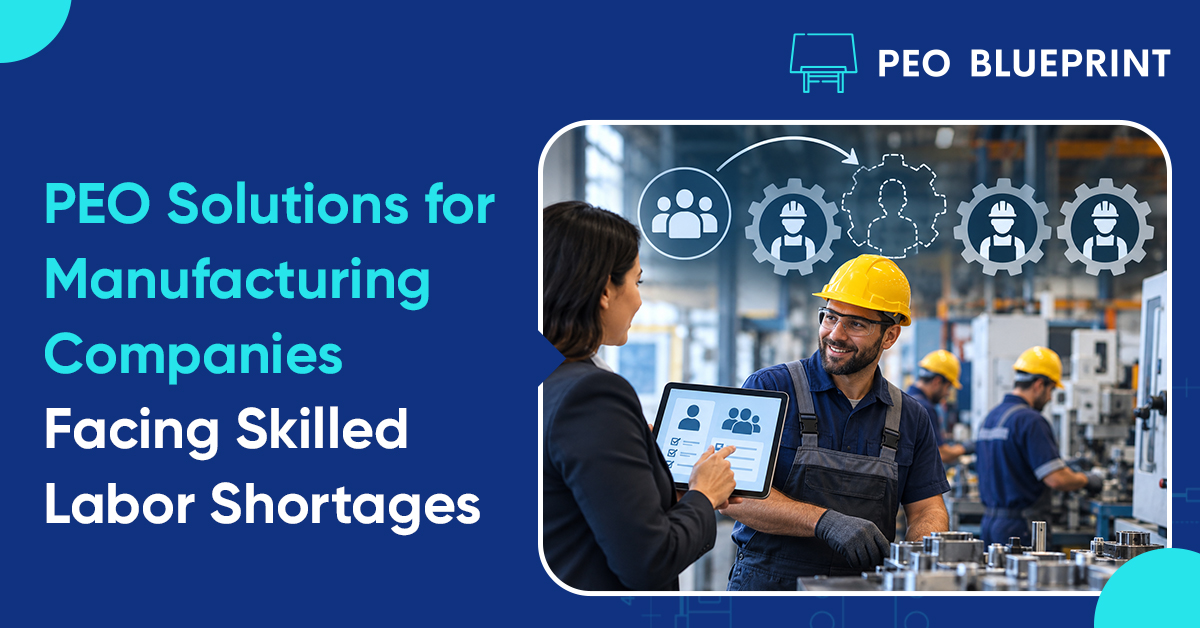
The modern industrial landscape faces an unprecedented operational crisis. Plant managers, human resource directors, and manufacturing executives grapple daily with empty assembly lines, delayed production schedules, and skyrocketing recruitment costs. PEO Solutions for Manufacturing Companies have emerged as a premier operational tool for mid-market and growing manufacturers seeking to overcome severe talent deficits, streamline complex compliance burdens, and secure high-caliber talent.
As veteran plant workers reach retirement age and younger generations gravitate toward other career paths, the manufacturing sector stands at a critical crossroads. Staying competitive requires more than basic hiring tactics; it demands a total transformation of how industrial organizations recruit, retain, and manage human capital. By leveraging a Professional Employer Organization (PEO), manufacturing facilities can instantly gain the administrative scale, comprehensive risk management, and enterprise-grade benefits required to win the war for skilled labor.
The Skilled Labor Crisis in Modern Manufacturing
To solve a problem, executives must first comprehend its full scope. The manufacturing labor gap is not a temporary dip in the hiring pool; it is a structural demographic shift that threatens long-term operational viability across industrial sectors.
+-------------------------------------------------------------------------------+
|                        THE MANUFACTURING TALENT GAP                           |
+-------------------------------------------------------------------------------+
|                                                                               |
|  [ Aging Workforce ] ---->  Mass Retirements (Knowledge Drain)                |
|                                                                               |
|  [ Skill Misalignment ] --> Advanced Robotics & Automation Gaps               |
|                                                                               |
|  [ Benefit Disparity ] ---> Small/Mid Plants Lost Talent to Enterprise Giants |
|                                                                               |
|  [ High Burnout ] -------> Administrative Overhead Distracts Leadership       |
|                                                                               |
+-------------------------------------------------------------------------------+
The manufacturing industry faces a massive structural talent deficit driven by several converging market forces:
• The Mass Retirement Wave: Thousands of experienced machinists, welders, mechanical technicians, and plant engineers are retiring weekly, taking decades of institutional knowledge with them.
• Advanced Technological Shifts: Modern manufacturing plants are no longer basic assembly floors. They are high-tech ecosystems driven by robotics, CNC machining, automated logistics, and IoT monitoring, requiring specialized technical skill sets that the current labor force lacks.
• Perception and Brand Challenges: Young job seekers often hold outdated views of manufacturing facilities, falsely viewing them as manual, dirty, or dead-end work environments rather than tech-forward career paths.
• Aggressive Compensation Competition: Small to mid-sized manufacturing enterprises constantly find themselves outbid by giant multinational corporations that can offer massive signing bonuses, extensive health coverage, and robust retirement plans.
According to research from the U.S. Bureau of Labor Statistics, open manufacturing jobs regularly hover near historic highs, while the rate of qualified applicants remains constrained. When specialized positions remain open for months, operational efficiency collapses, machine utilization drops, and plant managers face severe overtime expenses to keep up with production quotas.
What Is a PEO and How Does Co-Employment Function?
A Professional Employer Organization (PEO) provides comprehensive human resource management, payroll administration, regulatory compliance, and risk management through a formal business model known as co-employment.
                        +----------------------------+
                        |       CO-EMPLOYMENT        |
                        |        RELATIONSHIP        |
                        +--------------+-------------+
                                       |
                   +-------------------+-------------------+
                   |                                       |
                   v                                       v
    +------------------------------+       +------------------------------+
    |       PEO RESPONSIBILITY     |       |   MANUFACTURING COMPANY      |
    +------------------------------+       +------------------------------+
    | • Payroll & Tax Filing       |       | • Core Operations & Production|
    | • Benefits Administration    |       | • Daily Employee Supervision |
    | • Safety & OSHA Compliance   |       | • Quality Control & Output   |
    | • Workers' Comp Management   |       | • Strategic Business Growth  |
    +------------------------------+       +------------------------------+
Under a co-employment agreement, the administrative responsibilities of running a manufacturing business are divided between your executive team and the PEO partner:
• The Manufacturing Company Maintains Full Control: Your leadership retains 100% operational command over day-to-day work, job assignments, production targets, hiring decisions, operational strategy, and workplace culture.
• The PEO Handles Administrative Infrastructure: The PEO serves as the employer of record for tax purposes, absorbing payroll administration, employee benefits management, unemployment insurance processing, safety audits, and workplace regulatory compliance.
By partnering with a PEO, a manufacturing business immediately leverages the collective buying power of tens of thousands of worksite employees across the PEO’s entire client portfolio. This scale enables small and mid-sized industrial operators to access enterprise-level benefits and legal infrastructure at a fraction of the typical market cost.
For a detailed analysis of structural co-employment models tailored to industrial operators, review our strategic insights on PEO Solutions for Manufacturing Companies to see how administrative co-ownership unleashes internal growth.
Strategic Advantages of PEO Solutions for Manufacturing Companies
When manufacturing executives decide to address labor shortages, their first instinct is often to increase recruitment advertising budgets or raise base hourly pay. While competitive pay matters, sustained talent acquisition requires a holistic approach that tackles employee satisfaction, work environment, and long-term security.
Here is how co-employment partnerships transform talent metrics across industrial facilities:
1. Attracting High-Caliber Technicians with Enterprise Benefits
Skilled CNC operators, maintenance electricians, and quality control engineers rarely choose an employer based solely on hourly pay rates. They look for stable long-term career environments that protect their families.
Small to mid-sized manufacturers often struggle to offer attractive benefit packages because of high market premiums. A PEO levels the playing field completely.
✅ Access to Tier-One Health Insurance: Offer top-rated medical, dental, and vision coverage from major national carriers that would otherwise be cost-prohibitive for an independent plant.
✅ Robust Retirement Plans: Provide enterprise-grade 401(k) programs with automated compliance, low fund management fees, and streamlined employer-matching capabilities.
✅ Comprehensive Ancillary Coverage: Present complete coverage options including short-term and long-term disability, life insurance, accident protection, and critical illness policies.
✅ Wellness and Employee Assistance Programs (EAPs): Supply confidential mental health services, financial counseling, and wellness incentives that lower burnout among shift workers.
When small industrial facilities present benefits packages that match or exceed those offered by Fortune 500 competitors, candidate conversion rates increase dramatically.
2. Modernizing Onboarding and Recruitment Systems
First impressions dictate early employee turnover. If a newly hired machinist spends their first morning filling out manual paper forms on a clipboard in a noisy factory office, their perception of your company’s professionalism plummets immediately.
PEOs replace outdated administrative friction with modern technology suites:
✅ Digital Self-Service Onboarding: New hires complete tax forms, direct deposit setups, safety briefings, and benefit enrollments directly from a mobile app or laptop before their first day on the factory floor.
✅ Integrated Applicant Tracking Systems (ATS): PEO partners provide modern software to syndicate job postings across major job boards, track applicant pipelines, schedule interviews, and execute rapid background checks.
✅ Faster Time-to-Hire Execution: Streamlined candidate processing prevents qualified welders and technicians from accepting rival offers while waiting on slow internal paperwork.
3. Reducing Turnover Through Active Employee Retention Strategies
Replacing a skilled manufacturing worker costs between 1.5x and 2x their annual salary, including lost production output, equipment downtime, and recruitment expenses. Retention is the single most effective weapon against labor shortages.
PEOs deliver structural support designed to keep experienced workers engaged on the shop floor:
✅ Structured Career Development Paths: Establish clear skill-tracking frameworks and performance milestones so workers understand their long-term growth and compensation trajectory.
✅ Competitive Wage Benchmarking: Utilize real-time geographic and industry data to ensure your compensation structures remain competitive within your specific region.
✅ Modern HR Technology Portals: Give employees immediate access to pay stubs, W-2 forms, benefit coverage documents, and time-off requests via intuitive mobile applications.
To see how your organization’s benefits strategy compares with modern benchmarks, explore our research on PEO Solutions for Manufacturing Companies to optimize your human capital investment.
Operational Comparison: Independent HR vs. PEO Partnership
To visualize the tangible impact of a PEO partnership, examine how daily operational functions shift across key HR categories within a manufacturing plant:
| HR & Operational Function | Independent Manufacturing Plant | Manufacturing Plant with a PEO Partner |
| Health Benefits Sourcing | High annual rate increases, limited plan choices, high deductibles | Enterprise-grade carrier plans, stable rates, Fortune 500 benefits |
| Workers’ Compensation | Large upfront annual deposits, volatile audit adjustments | Pay-as-you-go billing, negotiated group rates, zero audit surprises |
| OSHA Safety Compliance | In-house team struggles with changing regulations and audits | Expert safety audits, customized training, hands-on OSHA inspection support |
| Payroll & Tax Administration | Manual processing, multi-state tax filing liabilities, paper documentation | Fully automated payroll, guaranteed tax filing compliance, mobile access |
| HR Regulatory Risk | Executive team personally liable for employment law mistakes | Shared risk model with dedicated HR legal specialists ensuring compliance |
| Recruitment Infrastructure | Fragmented job boards, manual applicant screening, slow onboarding | Integrated ATS platforms, automated screening, digital self-boarding |
Mitigating Risk, Safety, and Workers’ Compensation Costs
Manufacturing environments carry inherent physical risks. Machine operation, heavy material handling, chemical exposure, and complex assembly lines create significant exposure to workplace injuries and regulatory liabilities.
High workers’ compensation premiums directly erode operational margins, restricting a manufacturer’s ability to offer higher wages to attract talent.
+-------------------------------------------------------------------------------+
|                      RISK & SAFETY MANAGEMENT CYCLE                           |
+-------------------------------------------------------------------------------+
|                                                                               |
|   [ On-Site Safety Audits ] ----> Identifies Machine & Floor Hazards          |
|                                                                               |
|   [ Custom Safety Training ] ---> Trains Shift Workers in Multi-Language      |
|                                                                               |
|   [ Claims Management ] ------> Reduces Fraud & Accelerates Return-to-Work    |
|                                                                               |
|   [ Lower Experience Mod ] ---> Drives Down Workers' Comp Overhead Costs      |
|                                                                               |
+-------------------------------------------------------------------------------+
PEO partners act as proactive risk management allies, lowering workplace hazards and controlling compensation costs through specialized interventions:
Master Workers’ Compensation Policies
Independent manufacturers often face massive upfront premium deposits and unpredictable annual payroll audits. PEOs provide access to master workers’ compensation policies that feature negotiated group rates, zero upfront deposits, and pay-as-you-go billing tied directly to actual payroll cycles.
On-Site Safety Assessments and OSHA Training
PEOs deploy certified risk safety specialists directly to your plant floor to execute comprehensive safety evaluations:
• Hazard Identification: Identifying machinery guarding issues, ergonomic hazards, improper material storage, and personal protective equipment (PPE) gaps.
• Customized Safety Manuals: Developing multilingual safety manuals, standard operating procedures, and emergency response plans tailored to your factory layout.
• OSHA Audit Preparedness: Ensuring your recordkeeping, Form 300 logs, and safety committee documentation fully satisfy standards enforced by the Occupational Safety and Health Administration.
Proactive Claims Management and Return-to-Work Programs
When workplace accidents occur, unmanaged claims can cause your Experience Modification Rate (EMR) to skyrocket and drive up insurance costs for years. PEO risk teams oversee claims from day one:
• Directing injured workers to qualified medical providers immediately.
• Investigating claim legitimacy to stop fraudulent filings.
• Designing light-duty return-to-work programs that keep workers engaged while lowering overall indemnity costs.
Lowering risk metrics saves substantial capital—funding higher compensation packages for in-demand machinists and technicians.
Step-by-Step Implementation: Integrating a PEO into Your Plant
Transitioning your manufacturing business to a co-employment model requires a structured operational plan to guarantee seamless continuity across payroll, benefits, and plant management.
  +-----------------------------------------------------------------------+
  | STEP 1: Comprehensive HR, Risk, and Benefits Audit                    |
  +-----------------------------------------------------------------------+
                                      |
                                      v
  +-----------------------------------------------------------------------+
  | STEP 2: PEO Selection and Custom RFP Evaluation                       |
  +-----------------------------------------------------------------------+
                                      |
                                      v
  +-----------------------------------------------------------------------+
  | STEP 3: System Integration and Data Migration                         |
  +-----------------------------------------------------------------------+
                                      |
                                      v
  +-----------------------------------------------------------------------+
  | STEP 4: Employee Communication and Open Enrollment                    |
  +-----------------------------------------------------------------------+
                                      |
                                      v
  +-----------------------------------------------------------------------+
  | STEP 5: Go-Live, Safety Implementation, and Continuous Support        |
  +-----------------------------------------------------------------------+
Step 1: Execute a Comprehensive HR, Risk, and Benefits Audit
Before contacting PEO providers, compile a complete audit of your current human resource footprint:
- Gather workers’ compensation claims history from the past three to five years.
- Itemize current health insurance renewal costs, employee contribution levels, and participation rates.
- Review your internal turnover rates, average time-to-fill for open technical roles, and payroll processing expenses.
Step 2: Conduct PEO Selection and RFP Evaluation
Not every PEO specializes in blue-collar industrial environments. Evaluate prospective partners based on criteria designed for manufacturing needs:
- Confirm accreditation by the Employer Services Assurance Corporation (ESAC) and IRS certification as a Certified Professional Employer Organization (CPEO).
- Assess their experience handling heavy manufacturing risk profiles, complex shifts, differential pay scales, and multi-state operations.
- Verify that their master workers’ compensation program covers your exact industrial classification codes.
Step 3: Manage System Integration and Data Migration
Once a PEO partner is chosen, technical integration begins:
- Map existing time-and-attendance hardware, shift tracking tools, and ERP systems directly to the PEO’s payroll platform.
- Securely transfer historical employee records, tax withholdings, direct deposit credentials, and wage garnishments into the new database.
- Set up customized shift differential rules, overtime calculations, and paid time off accrual policies in the software.
Step 4: Launch Clear Employee Communications and Open Enrollment
Change can create anxiety on the factory floor if you don’t communicate it transparently. Frame the PEO transition as a major upgrade for staff:
- Host multi-shift informational meetings led by executive management and PEO representatives.
- Emphasize improved benefit offerings, mobile payroll tools, and expanded family care options.
- Conduct guided open-enrollment sessions to help employees select optimal health plans.
Step 5: Execute Go-Live and Ongoing Operational Alignment
With setup complete, the co-employment partnership launches:
- Run parallel payroll test cycles before official go-live to verify data accuracy across all plant departments.
- Conduct your first on-site PEO safety audit to identify immediate hazard reduction opportunities.
- Schedule monthly alignment reviews between your HR team and the PEO account manager to review open requisitions, claims statuses, and compliance updates.
For a detailed blueprint for selecting the right partner for your facility, access our step-by-step guidance on PEO Solutions for Manufacturing Companies to ensure a smooth onboarding transition.
Overcoming Key Challenges When Adopting a PEO Model
While co-employment delivers significant advantages, manufacturing leadership teams often face specific operational concerns during initial evaluation. Addressing these challenges directly ensures smooth implementation:
+-------------------------------------------------------------------------------+
|                       COMMON CONCERNS VS. REALITY                             |
+-------------------------------------------------------------------------------+
|                                                                               |
|  CONCERN: "We will lose control of our factory workers."                      |
|  REALITY: You retain 100% operational command over hiring, firing, production,|
|           and plant safety directives.                                        |
|                                                                               |
|  CONCERN: "Our employees will be confused by a co-employer name."             |
|  REALITY: Transparent communication highlights upgraded benefits and improved |
|           payroll technology, boosting morale.                                |
|                                                                               |
|  CONCERN: "PEO solutions are too expensive for small plants."                 |
|  REALITY: Admin savings, lower workers' comp rates, and health insurance      |
|           discounts consistently create a net-positive ROI.                   |
|                                                                               |
+-------------------------------------------------------------------------------+
Addressing Concerns About Operational Control
A common misconception among business owners is that partnering with a PEO means giving up authority over workplace decisions.
In practice, co-employment creates a distinct division of labor. Your plant managers dictate daily tasks, safety standards, production lines, shift schedules, and cultural values. The PEO functions as your back-office human resources engine, absorbing paperwork, regulatory filings, and tax reporting.
Managing Software and Time-Tracking Integrations
Modern industrial plants rely heavily on specialized time clock hardware, job costing applications, and Enterprise Resource Planning (ERP) systems like SAP, Epicor, or Plex.
Leading PEOs offer flexible API integrations that let existing shop floor systems send attendance and job-costing data straight to payroll without manual data entry.
Navigating Multi-State Regulatory Compliance
If your manufacturing business operates facilities across multiple states, managing varying state tax laws, paid sick leave mandates, and workers’ compensation rules becomes overwhelming.
PEOs maintain legal compliance teams across all 50 states, ensuring your operations remain compliant regardless of where your plant facilities or remote technicians are located.
Real-World Case Studies: How Manufacturing Facilities Win with PEOs
Examining how peer companies navigate labor shortages illustrates the tangible power of co-employment solutions.
+-------------------------------------------------------------------------------+
|                      MANUFACTURING CASE STUDY IMPACT                          |
+-------------------------------------------------------------------------------+
|                                                                               |
| [ Precision CNC Machine Shop ] -----> Turnover Dropped 42% in 12 Months       |
|                                      Saved $64,000 on Workers' Comp           |
|                                                                               |
| [ Industrial Equipment Fabricator ] -> Time-to-Fill Reduced from 72 to 24 Days|
|                                      Open Positions Filled 3x Faster          |
|                                                                               |
+-------------------------------------------------------------------------------+
Case Study 1: Mid-Sized Precision CNC Machine Shop
A midwestern precision machining plant with 85 employees struggled with severe employee turnover. Competitor plants were poaching experienced tool-and-die makers by offering lower-deductible health plans.
• The PEO Intervention: The company partnered with an accredited PEO, gaining access to a master health plan that lowered employee deductibles by 60% while stabilizing employer premiums. The PEO also implemented an on-site safety program that improved the plant’s EMR rating.
• The Measurable Result: Turnover plummeted by 42% in the first 12 months. The company saved $64,000 in annual workers’ compensation costs, which were reinvested directly into performance bonuses for senior technicians.
Case Study 2: Rapidly Growing Industrial Equipment Fabricator
An industrial fabrication business with 140 workers across two locations was losing contracts because empty assembly positions restricted production capacity. Their small internal HR team was overwhelmed by routine administrative tasks, leaving zero time for recruitment.
• The PEO Intervention: The manufacturer adopted a PEO solution that integrated an advanced Applicant Tracking System and automated digital onboarding. The PEO’s risk team managed all compliance paperwork, freeing the internal HR manager to focus entirely on local talent sourcing.
• The Measurable Result: Average time-to-fill for open welding and assembly roles dropped from 72 days to 24 days. Plant throughput increased by 28% within six months as we filled open positions with qualified candidates.
Frequently Asked Questions (FAQs)
What is the primary difference between a PEO and a traditional staffing agency?
A staffing agency recruits temporary or contract workers to fill short-term labor needs. A PEO does not supply temporary workers. Instead, a PEO enters a co-employment relationship to manage HR, benefits, payroll, and compliance for your existing full-time workforce, helping you retain permanent skilled talent.
How does a PEO calculate its service fees for manufacturing clients?
PEOs typically charge fees using one of two common pricing structures:
• Fixed Per-Employee-Per-Month (PEPM) Fee: A predictable monthly dollar amount charged per active employee, regardless of wage levels.
• Percentage of Payroll Fee: A set percentage based on total gross payroll run per pay period.
For manufacturing companies with variable overtime hours, a fixed PEPM model often provides greater budget predictability.
Can a manufacturing company keep its current insurance broker when joining a PEO?
Many PEOs offer broker-friendly partnership models. This lets your business keep its trusted insurance broker while still accessing the PEO’s administrative software, payroll infrastructure, and risk management systems.
Will partnering with a PEO disrupt our daily shop floor operations?
No. Co-employment changes administrative back-office execution, not day-to-day operations. Your supervisors retain total operational control over work schedules, machine operations, job assignments, quality standards, and plant management.
Is a Certified PEO (CPEO) necessary for a manufacturing business?
Partnering with an IRS-certified CPEO provides major financial security benefits. A CPEO takes sole financial liability for paying federal employment taxes, eliminating double-taxation risks for your business if errors occur. CPEO status also requires strict quarterly financial audits by independent CPAs.
Secure Your Manufacturing Workforce with Modern Co-Employment Solutions
The skilled labor shortage in manufacturing is not a temporary inconvenience—it is a long-term business environment that requires modern operational solutions. Continuing to rely on outdated HR practices, expensive individual insurance plans, and manual administrative workflows leaves your plant vulnerable to high turnover, rising costs, and lost market share.
Implementing targeted PEO Solutions for Manufacturing Companies transforms human resources from a costly administrative burden into a competitive advantage. With enterprise-grade health coverage, modern recruitment tools, streamlined safety programs, and automated payroll systems, your company can attract top-tier technicians and retain the experienced talent needed to keep assembly lines running smoothly.
Take control of your workforce strategy today. Evaluate your administrative costs, benchmark your benefits offerings against industry leaders, and discover how co-employment partnerships protect your operational margins while positioning your plant for long-term growth.