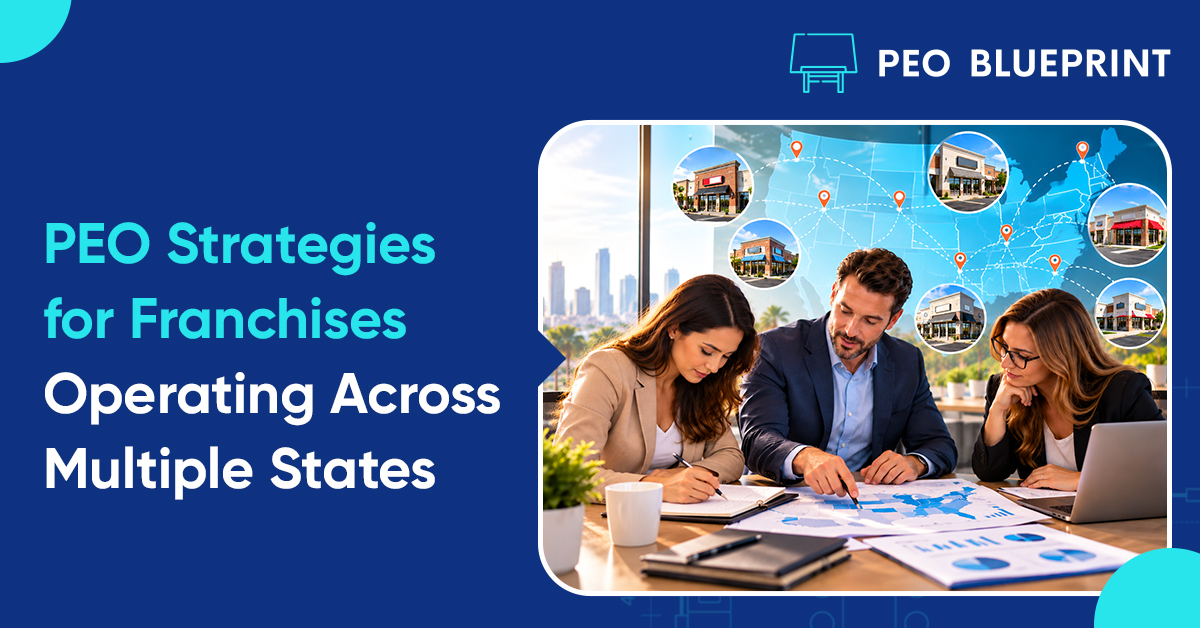
Franchises can grow faster than traditional businesses because their operating model is designed for replication. However, expansion across state lines introduces a complex workforce challenge. Every new location can bring different payroll rules, employment requirements, tax obligations, workers’ compensation rules, and employee expectations. PEO Strategies for Franchises can help franchise systems create a more consistent and scalable approach to managing these responsibilities.
A professional employer organization, or PEO, supports businesses with payroll, human resources, benefits administration, risk management, and employment compliance. For franchise owners operating across multiple states, the right PEO relationship can reduce administrative friction while giving managers more time to focus on customers, sales, staffing, and local operations.
The key is not simply choosing a PEO. Franchise organizations need a deliberate strategy that connects PEO services with their growth model, ownership structure, workforce needs, and compliance requirements. A thoughtful approach can create consistency without taking away the local flexibility that makes franchising successful.
Why Multistate Franchising Creates HR Complexity
Operating one franchise location is relatively straightforward. Operating dozens of locations across several states is different because employment rules can vary significantly from one jurisdiction to another. A process that works well in one state may need changes elsewhere.
Franchisees may have different staffing levels, wage structures, benefits preferences, scheduling practices, and hiring challenges. Meanwhile, franchisors often want consistent standards across the entire brand. This creates a delicate balance between centralized support and local decision-making.
PEO Strategies for Franchises should therefore begin with a clear understanding of where administrative consistency matters most and where local flexibility remains necessary.
Common multistate challenges include:
• State and local payroll tax registration
• Different minimum wage requirements
• Paid sick leave and paid leave regulations
• State-specific workers’ compensation requirements
• New-hire reporting obligations
• Employee classification and overtime compliance
• Benefits administration across different locations
• Employee onboarding and recordkeeping
• State unemployment insurance requirements
• Changing employment legislation
These responsibilities become more difficult as a franchise network expands. Manual administration can create inconsistent practices, missed deadlines, and unnecessary costs.
PEO Strategies for Franchises That Support Scalable Growth
A PEO can become an operational extension of a franchise business, not just another payroll vendor. The strongest approach integrates payroll, HR, compliance, benefits, and risk management into a coordinated workforce strategy.
For franchise organizations, that strategy should support both corporate goals and individual franchisee needs. The PEO should understand how the franchise agreement works, how franchisees interact with the brand, and which employment responsibilities each business entity retains.
A scalable strategy can help franchisees establish repeatable HR processes from the beginning. Instead of rebuilding payroll and HR procedures whenever a new location opens, the organization can use standardized workflows supported by centralized expertise.
Key benefits may include:
 More consistent payroll administration across locations
Better visibility into workforce costs
Reduced administrative workload for franchise owners
Stronger employee onboarding processes
Centralized HR support with local compliance awareness
Easier expansion into additional states
The goal isn’t to make every location identical. The objective is to build a dependable infrastructure that lets each location operate efficiently within applicable laws.
Build a State-by-State Compliance Framework
One of the most important PEO Strategies for Franchises is creating a state-by-state compliance framework before expansion begins. Franchise leaders should identify the workforce requirements for each operating location and establish a process to monitor changes.
The U.S. Small Business Administration notes that businesses operating in more than one state may need to complete additional registration or foreign qualification requirements. Employment activity can also trigger state-specific obligations. U.S. Small Business Administration
A PEO can help coordinate many employment-related processes, but franchise leadership should still understand where legal and operational responsibilities sit.
Start by creating a compliance inventory covering:
• State payroll taxes
• Unemployment insurance
• Workers’ compensation
• Wage and hour requirements
• Required workplace notices
• Leave requirements
• Hiring and termination procedures
• Employee classification
• Record retention
• Required registrations
This framework should be a living document, not a one-time checklist. States frequently change employment requirements, and a multistate franchise needs a process to identify and implement those changes.
Standardize Payroll Without Ignoring Local Rules
Payroll is one of the biggest operational pressure points for multistate franchises. Employees may work under different minimum wage rules, overtime requirements, tax structures, and local ordinances depending on where they work.
A centralized PEO payroll platform can provide a consistent administrative process while applying location-specific rules. This creates a stronger foundation for accurate payroll processing and reporting.
The goal should be centralization with controlled localization. Franchise owners shouldn’t have to become payroll tax experts, but they should have access to clear reports showing labor costs, payroll changes, taxes, and other key workforce data.
A strong payroll strategy should include:
Centralized payroll processing
Automated tax calculations and filings where applicable
State-specific payroll configuration
Standardized payroll calendars
Clear approval workflows
Payroll reporting for franchise owners
When payroll processes become standardized, franchise organizations can reduce manual work and make expansion more predictable.
Use PEO Benefits Administration to Strengthen Recruitment
Hiring challenges can become a major barrier to franchise growth. Restaurant, retail, hospitality, healthcare, fitness, and service franchises often compete for employees in crowded labor markets.
Benefits can help franchises attract and retain qualified employees. Still, smaller franchisees may struggle to offer competitive programs on their own. A PEO may provide access to broader benefits administration capabilities and established processes.
A strategic benefits program can include:
• Health insurance administration
• Retirement plan support
• Employee assistance resources
• Voluntary benefits
• Benefits enrollment technology
• Employee communication
Benefits should also be presented consistently across the franchise network. Employees should understand what their benefits offer, when enrollment occurs, and who to contact with questions.
This creates a more professional employee experience and can strengthen the overall franchise brand.
For additional workforce planning guidance, franchise leaders can explore the resources available through PEO Blueprint.
Centralize HR While Preserving Franchisee Control
A successful PEO relationship should not remove the franchisee’s role as an operator. Franchise owners still need to decide on staffing, performance, scheduling, customer service, and local business priorities.
The PEO should provide infrastructure, expertise, and administrative support. Franchise leadership should retain appropriate operational authority.
This distinction matters most when establishing HR policies. A centralized policy can create consistency, but it should also account for applicable state and local requirements.
A practical division of responsibilities may look like this:
• Franchise owner: daily supervision and operational decisions
• Franchise manager: scheduling, coaching, and location-level execution
• PEO: payroll, HR administration, benefits, and compliance support
• Franchisor: brand standards, strategic guidance, and system-wide expectations
Clear responsibilities reduce confusion and help prevent duplicated work.
Improve Employee Onboarding Across Every Location
Franchise systems frequently hire employees at different locations at different times. Without standardized onboarding, new employees may receive inconsistent information about policies, benefits, payroll, safety, and workplace expectations.
A PEO can help create a repeatable onboarding workflow that franchisees can use across locations.
An effective onboarding process should cover:
- Collect required employee information and employment documents.
- Complete required federal, state, and local onboarding steps.
- Explain payroll schedules, benefits, workplace policies, and expectations.
- Assign required training based on the employee’s position.
- Confirm that managers complete location-specific orientation.
Standardization creates a stronger employee experience without preventing franchisees from adding local training.
Strengthen Workforce Data and Reporting
Multistate franchise organizations need reliable workforce data to make good decisions. Labor costs can make up a significant share of operating expenses, so leaders need accurate information on staffing levels, overtime, turnover, wages, and benefits.
A PEO can consolidate workforce information into standardized reports. This lets franchise leaders compare locations more effectively and spot patterns.
Useful metrics include:
• Payroll cost as a percentage of revenue
• Employee turnover
• Overtime hours
• Average time to hire
• Benefits participation; workers’ compensation claims
• Absence rates
• Headcount by location
The value comes from turning raw workforce information into actionable insight. If one location consistently experiences high turnover, leadership can investigate scheduling, management practices, compensation, training, or local labor conditions.
Workers’ Compensation: More Strategic. Workers’ compensation becomes more complicated when employees work across multiple states. Each state can have its own regulatory framework, insurance requirements, filing procedures, and administrative expectations.
Depending on the arrangement and services offered, a PEO can provide centralized support for workers’ compensation administration and claims coordination.
Franchise leaders should evaluate how the PEO handles:
• Coverage requirements
• Claims reporting
• Incident documentation
• Employee communication
• Return-to-work processes
• Safety resources
• Claims management
Safety should remain an operational priority at every location. A PEO can support the administrative infrastructure, but franchise managers must still maintain safe workplaces and enforce appropriate procedures.
Evaluate PEOs’ Multistate Capabilities
Not every PEO suits franchise organizations. Franchise leaders should evaluate providers based on their ability to support the network’s actual complexity.
The selection process should examine experience with multistate employers, franchise structures, workforce size, industry-specific risks, and expansion plans.
Ask prospective providers:
• How many states do you actively support?
• How do you monitor changing employment requirements?
• Do you work with franchise organizations?
• How are franchisees onboarded?
• What payroll and HR technology do you provide?
• What compliance support is included?
• How are workers’ compensation programs administered?
• What benefits options are available?
• What reporting can franchise leadership access?
• Who owns the client relationship?
The strongest provider is not necessarily the largest. The better choice is the PEO that can support the franchise’s operating model and future growth.
Verify PEO Certification and Financial Strength
Franchise organizations should conduct careful due diligence before signing a PEO agreement. Certification can matter, especially when evaluating federal employment tax responsibilities.
The IRS maintains a voluntary certification program for PEOs. Certified Professional Employer Organizations, or CPEOs, must satisfy requirements involving areas such as financial responsibility, tax compliance, and organizational integrity. IRS — Certified Professional Employer Organization
The IRS also publishes a current public listing of certified PEOs. IRS — CPEO Public Listings
This does not mean certification alone should determine the decision. Franchise leaders should also examine the provider’s financial stability, technology, service model, insurance arrangements, customer support, contract terms, and experience.
The due diligence process should include:
Reviewing certification status
Checking financial stability
Reviewing service agreements carefully
Confirming insurance and risk-management arrangements
Assessing technology and reporting capabilities
Speaking with comparable clients
A thorough evaluation reduces the risk of selecting a provider that cannot support the network as it expands.
Understand Employment Tax Responsibilities
PEO arrangements can change how certain employment tax responsibilities are handled, particularly when the PEO is IRS-certified, and the arrangement qualifies under applicable rules.
The IRS explains that a CPEO may assume certain federal employment tax responsibilities for covered worksite employees under a qualifying CPEO contract. However, the precise allocation of responsibility depends on the agreement and applicable federal requirements. IRS — CPEO Customer Guidance
Franchise leaders should never assume that outsourcing payroll eliminates every employer responsibility. The contract should clearly explain what the PEO handles and what remains with the franchisee.
This distinction matters because franchise businesses often operate through separate legal entities. Each entity should receive appropriate legal, tax, and employment guidance based on its specific circumstances.
Create a Consistent Franchise HR Playbook
A franchise HR playbook can connect PEO services with day-to-day operating procedures. The playbook should explain how franchisees handle hiring, onboarding, payroll approvals, employee documentation, benefits, performance management, workplace incidents, and separations.
A consistent playbook reduces the time franchise owners spend deciding what to do next. It also makes training easier when new franchisees or managers join the system.
The playbook should clearly distinguish between:
• Brand requirements
• PEO-supported processes
• Franchisee responsibilities
• State-specific requirements
• Location-specific procedures
This structure gives franchisees practical guidance without creating the false impression that every state follows identical employment rules.
Monitor Changes in Employment Regulations
Employment compliance cannot be treated as a once-a-year project. Federal, state, and local rules can change throughout the year.
The U.S. Department of Labor continues to update guidance and rulemaking related to employment relationships and wage-and-hour requirements. Franchise organizations should establish a process to receive, review, and implement regulatory updates. U.S. Department of Labor
A PEO can help because monitoring employment requirements is part of its core service model.
However, franchise leaders should still maintain internal accountability. Regulatory alerts have little value if managers do not implement required changes.
Build a Scalable Expansion Process
The best PEO Strategies for Franchises are designed before rapid expansion creates administrative pressure. Every new state should follow a repeatable implementation process.
A franchise expansion checklist might include:
- Identify the legal entity operating the new location.
- Confirm state and local registration requirements.
- Establish payroll and unemployment accounts as needed.
- Configure state-specific employment requirements.
- Confirm workers’ compensation arrangements.
- Train local management.
- Launch payroll and HR reporting.
- Review the first payroll cycles carefully.
- Conduct a post-launch compliance review.
This process can make expansion more predictable. Instead of treating every new location as a unique HR project, the organization develops a repeatable system.
Improve Communication Between Franchisor, Franchisee, and PEO
Technology alone cannot solve communication problems. A strong three-way relationship between the franchisor, franchisee, and PEO is essential.
Franchisees should know where to send payroll questions, HR concerns, benefits issues, and compliance questions. Franchisors should understand the information they can receive from the PEO and the limits imposed by privacy or contractual requirements.
Regular communication can include:
• Monthly operational reviews
• Quarterly workforce reporting
• Compliance updates
• Benefits enrollment planning
• New-location launch meetings
• Annual PEO performance reviews
Clear communication creates accountability and helps identify problems before they become expensive.
Control Costs Without Sacrificing Compliance
Franchise owners often evaluate PEOs based on administrative fees. While pricing matters, the lowest-cost provider may not produce the lowest total cost.
A better analysis considers the full value of the relationship. Administrative efficiency, reduced compliance risk, stronger benefits, improved retention, better reporting, and faster expansion can all affect the total economic outcome.
Franchise leaders should compare:
• PEO administrative fees
• Payroll processing costs
• Benefits costs
• Workers’ compensation expenses
• InWorkers’R labor
• Technology expenses
• Compliance support
• Implementation costs
• Termination or transition fees
The right PEO should create measurable operational value, not just move expenses from one budget category to another.
Use Technology to Create Operational Consistency
Modern PEO platforms can centralize payroll, employee records, benefits, onboarding, time tracking, and HR administration. This creates a single operational environment for franchise networks.
Technology becomes particularly valuable when employees and managers work across multiple locations. A centralized system can reduce duplicate data entry and improve access to workforce information.
However, franchise leaders should evaluate usability as carefully as functionality. A powerful platform that franchise managers cannot use effectively will create more problems than it solves.
Important technology considerations include:
Mobile access
Payroll integration
Employee self-service
Benefits enrollment
Time and attendance integration
Reporting dashboards
Document management
Security controls
Technology should simplify the franchise operating model, not add complexity.
Prepare for Growth Before You Need It
One of the most common mistakes in franchise expansion is waiting until the organization becomes difficult to manage before upgrading its HR infrastructure.
A business with five locations may manage payroll and HR manually. A business with 50 or 100 locations needs a much stronger system.
Franchise leadership should therefore select a PEO based not only on current requirements but also on the next stage of growth.
Consider where the organization expects to be in three to five years. If expansion could involve new states, new job categories, acquisitions, or a larger employee population, the PEO must support that trajectory.
Scalability should be part of the original selection criteria, not an emergency response to growth.
Common PEO Mistakes Franchise Organizations Should Avoid
Even a strong PEO can fail to deliver value when the relationship is poorly structured. Franchise organizations should avoid treating the PEO as a replacement for management.
Common mistakes include:
• Choosing a provider based only on price
• Assuming every state has identical requirements
• Failing to clarify employer responsibilities
• Giving franchisees unclear instructions
• Ignoring data security and privacy
• Not reviewing contract terms
• Failing to measure PEO performance
• Allowing outdated HR policies to remain in place
• Selecting technology without considering manager usability
• Waiting until expansion is underway to build compliance processes
Avoiding these mistakes helps franchise organizations turn the PEO relationship into a strategic operating advantage.
Measure PEO Performance With Clear KPIs
A PEO relationship should be measurable. Franchise leadership should establish key performance indicators before implementation and review them regularly.
Useful KPIs can include:
• Payroll accuracy
• Payroll processing timeliness
• HR response time
• Employee onboarding completion
• Benefits enrollment accuracy
• Workers’ compensation claim performance
• Employee turnover
• Compliance issues
• Franchisee satisfaction
• Cost per employee
Tracking these metrics makes it easier to identify whether the PEO is delivering meaningful value. It also gives franchise leadership objective information during contract renewal discussions.
The Strategic Role of a PEO in Franchise Growth
The most effective PEO Strategies for Franchises go beyond payroll processing. They build a workforce infrastructure that supports consistent operations while letting franchisees focus on customers and local markets.
A PEO can help standardize administrative processes, improve access to benefits, strengthen HR support, and simplify certain compliance responsibilities. These advantages become increasingly valuable as a franchise network crosses state boundaries.
The relationship should remain strategic. Franchise leaders need to understand their responsibilities, monitor provider performance, and ensure that the PEO’s capabilities align with the organization’s growth objectives.
A well-designed PEO strategy also improves the franchisee organization. When owners receive reliable payroll, HR, benefits, and compliance support, they can spend more time on revenue-generating activities and less time navigating administrative complexity.
Final Takeaway: Build the Right Workforce Infrastructure
Multistate franchise growth creates opportunities, but it also increases workforce complexity. Payroll, HR administration, benefits, workers’ compensation, employment taxes, and state-specific compliance can quickly become difficult to manage through disconnected systems.
PEO Strategies for Franchises provide a framework for addressing that complexity through centralized expertise, standardized processes, scalable technology, and coordinated workforce administration.
The strongest strategy begins with due diligence. Franchise organizations should evaluate PEO experience, multistate capabilities, technology, financial strength, service quality, benefits options, compliance support, and contract terms before deciding.
From there, the organization should clearly define responsibilities among the franchisor, franchisee, and PEO. State-by-state compliance requirements should remain visible, while standardized payroll, onboarding, reporting, and HR processes create consistency across the network.
Growth should never require franchise owners to choose between operational speed and workforce compliance. With the right structure, a PEO can provide the infrastructure needed to expand confidently while maintaining a professional, consistent employee experience.
For franchise businesses planning their next stage of expansion, PEO Blueprint can serve as a useful resource for understanding how professional employer organization solutions can support growing workforces.
Ultimately, the goal is simple: build an HR and payroll system that scales as confidently as the franchise itself. When workforce administration becomes more organized, franchise owners gain more time to focus on customers, employees, profitability, and sustainable growth.