Introduction to M&A Human Capital Challenges
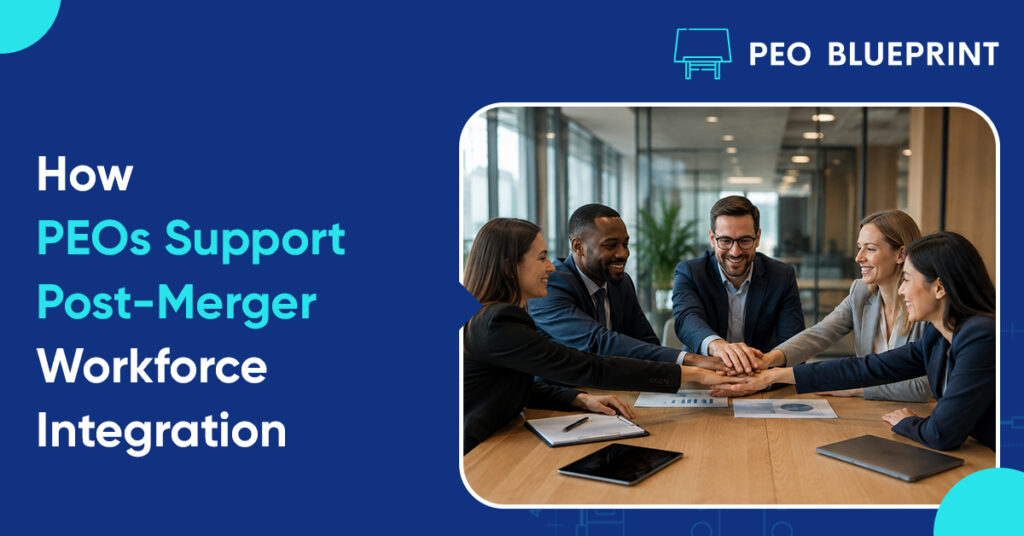
When a corporate merger or acquisition closes, the real operational work begins immediately. While executives celebrate the financial victory and strategic expansion, HR teams face the monumental task of blending two distinct companies. Mergers and acquisitions often look perfect on financial spreadsheets, but they frequently stumble during execution. The most significant hurdle is almost always human capital management and cultural alignment. If you want to retain top talent and maintain operational stability, you must understand how PEOs support post-merger workforce integration.
A Professional Employer Organization (PEO) provides the robust infrastructure needed to execute a flawless transition. Instead of forcing an overwhelmed internal HR department to untangle overlapping payroll systems, companies can leverage a co-employment model. This strategic partnership completely removes the administrative friction that typically plagues corporate mergers. By handling the heavy lifting of compliance and payroll, a PEO lets leadership focus on long-term growth.
The employee experience during an integration process is deeply personal and highly sensitive. Workers at the acquired company immediately worry about their job security, compensation structure, and healthcare coverage. A strong PEO eliminates this anxiety by providing immediate access to comprehensive benefit packages. In this guide, we explore how PEOs support post-merger workforce integration to preserve deal value and build a unified, thriving organizational culture.
The High Stakes of Human Capital in Corporate Acquisitions
Corporate mergers carry incredibly high stakes, yet many fail to achieve their projected value due to workforce mismanagement. When organizations consolidate, leaders often overemphasize financial metrics and operational synergies while neglecting the softer side of change management. This oversight directly leads to talent attrition, plummeting morale, and severe drops in productivity. If top performers leave because they feel uncertain about their future, the acquiring company loses the intellectual property they just purchased.
Understanding the people side of post-merger integration is essential for long-term success. According to research by the Boston Consulting Group, consistently gathering employee perspectives and feedback is crucial during periods of change. The deal’s objective—whether it focuses on rapid growth, aggressive cost-cutting, or a strategic turnaround—directly shapes employee sentiment. Leadership must engage both the hearts and minds of individuals across the organization to win their unwavering support.
Navigating these turbulent waters requires an expert touch and highly scalable resources. This is exactly where external HR consolidation partners step in to bridge the gap. By analyzing both the hard and soft HR metrics long before the ink dries, a co-employment provider accurately depicts the integration roadmap. They ensure that no crucial detail falls through the cracks during the chaotic first ninety days.
During an acquisition, HR teams often face these distinct challenges:
• Incompatible payroll processing schedules
• Different paid time off accrual rates
• Conflicting employee title hierarchies
• Varying remote work policies
• Duplicative software subscriptions
Demystifying the Co-Employment Model in M&A
Before diving into specific integration strategies, leaders must clearly understand how a Professional Employer Organization works. A PEO is a strategic outsourcing arrangement that handles payroll, onboarding administration, benefits, and workers’ compensation. Under this unique co-employment solution, the PEO becomes the employer of record for tax and insurance purposes. Meanwhile, the acquiring employer retains total responsibility for day-to-day operations, strategy, and direct management of the employees.
This distinct sharing of employer responsibilities allows small and mid-sized businesses to leverage massive economies of scale. By consolidating insurance purchasing for multiple employer groups into one massive master plan, PEOs offer significant price advantages. This mechanism completely transforms how PEOs support post-merger workforce integration. Instead of scrambling to negotiate new insurance rates for a slightly larger headcount, the newly merged company plugs into a massive, pre-negotiated infrastructure.
The financial and operational benefits of this model are thoroughly documented across the industry. A recent study demonstrated that businesses utilizing these services have double the growth rate of comparable businesses and a noticeably lower employee turnover rate. For a company attempting to digest a fresh acquisition, reducing turnover and maintaining growth are the ultimate goals.
Partnering with a co-employment provider offers these direct advantages:
✅ Reduces the heavy administrative burden on internal teams
✅ Stabilizes the company culture during a turbulent transition
✅ Provides immediate access to Fortune 500-level health plans
✅ Ensures strict compliance with state and federal labor laws
✅ Standardizes the onboarding experience for all new staff
How PEOs Support Post-Merger Workforce Integration: 7 Core Pillars
To grasp the value of HR outsourcing during an acquisition, break the integration process into distinct functional categories. Merging two workforces requires precision across multiple operational disciplines at once. Internal teams rarely have the capacity to manage daily operations while executing a flawless transition. Here is a deep dive into how PEOs support post-merger workforce integration across seven fundamental pillars.
Pillar 1: Seamless Benefits Harmonization and Upgrades
Nothing signals uncertainty to acquired employees faster than vague communications about their healthcare benefits. Will their preferred doctors remain in-network? When will the sudden changes take effect? What about their monthly premiums and out-of-pocket coverage levels? A strong PEO eliminates this intense anxiety by providing immediate, transparent access to comprehensive benefit packages. These newly introduced packages often exceed what the acquired company could ever offer independently.
Harmonizing two completely different benefit plans mid-year is a logistical nightmare for a standard HR department. You must reconcile different deductible cycles, varying employer contribution strategies, and distinct retirement matching formulas. PEOs support post-merger workforce integration by absorbing this complexity effortlessly. They seamlessly map the legacy benefits to their master plans, ensuring no employee experiences a dangerous gap in healthcare coverage.
This seamless continuation of critical benefits builds immediate trust and confidence among the newly acquired workforce. When employees see an upgrade in their healthcare, dental, and vision options, their fear of the acquisition quickly turns into genuine enthusiasm. Furthermore, the PEO manages the entire open enrollment process, handling all the confusing paperwork and answering individual employee questions via dedicated support centers.
Pillar 2: Unified Payroll Consolidation and Administration
Merging hourly warehouse crews with different shift structures and variable pay schedules is where M&A deals quietly fall apart. The acquiring company might run a bi-weekly payroll, while the acquired entity pays its staff semi-monthly. Discrepancies in overtime calculations, shift differentials, and bonus payouts create severe administrative bottlenecks. A primary way PEOs support post-merger workforce integration is by implementing a unified, enterprise-grade payroll infrastructure from day one.
The transition involves carefully migrating large volumes of sensitive financial data into a single centralized system. A dedicated co-employment partner ensures that every single employee receives their paycheck accurately and on time, without exception. This operational stability lets executive management focus on strategic integration priorities rather than getting bogged down in administrative firefighting.
Furthermore, the provider assumes full responsibility for calculating and remitting complex payroll taxes across jurisdictions. This eliminates the risk of missed tax deadlines or inaccurate withholdings that often occur during frantic M&A transitions. Employees gain access to a modern self-service portal where they can easily view their unified pay stubs, update direct deposit information, and download critical year-end tax documents.
Pillar 3: Managing Multi-State Regulatory Compliance
Corporate acquisitions frequently expand a company’s geographical footprint, creating a dangerous minefield of regulatory complexity. Employment laws vary significantly across different states, counties, and even individual municipalities. The acquiring company may possess absolutely no expertise in the specific states where the newly purchased business operates. Non-compliance with unfamiliar local labor laws carries incredibly serious financial penalties and legal consequences.
This is a critical area illustrating exactly how PEOs support post-merger workforce integration. Because the employees become W-2 members of the PEO staff under the co-employment agreement, the provider assumes significant compliance liabilities. They employ armies of legal experts who stay entirely current with shifting state and federal mandates, ranging from California’s strict overtime laws to New York’s mandatory paid family leave requirements.
When you cross state lines during an acquisition, you suddenly inherit new wage transparency laws, mandatory sick leave tracking, and complex termination protocols. The PEO immediately audits the acquired company’s practices to identify and neutralize any lingering compliance liabilities before they trigger devastating lawsuits. They guarantee that all required labor posters are digitally distributed and that every newly acquired employee completes a verified I-9 form properly.
Pillar 4: Streamlining Disparate HR Technology Stacks
A major headache during corporate consolidation is untangling the messy web of overlapping human resources software. The parent company might use Workday, while the acquired business heavily relies on a mix of legacy systems and scattered Excel spreadsheets. Forcing employees to log into five different portals to request time off or review their benefits generates immense frustration. PEOs support post-merger workforce integration by deploying a single, unified Human Resource Information System (HRIS).
This consolidation drastically reduces manual data-entry errors and securely centralizes employee records. The unified platform handles time and attendance tracking, performance management workflows, applicant tracking, and dynamic organizational charts. By completely standardizing the technology stack, the company dramatically accelerates the realization of M&A synergies and immediately reduces unnecessary software subscription costs.
A single source of truth for all human capital data empowers leadership to make informed, data-driven decisions. Executives can finally pull accurate headcount reports, analyze blended turnover metrics, and evaluate diversity statistics across the newly combined organization. The PEO ensures this vital technology implementation runs smoothly, providing extensive technical support and hands-on training for the entire workforce.
Pillar 5: Standardizing Employee Policies and Handbooks
When two distinct companies merge, their internal policy manuals inevitably clash. One organization might embrace a fully remote, flexible work environment, while the other strictly enforces a traditional in-office attendance policy. Discrepancies regarding paid time off approvals, dress codes, social media usage, and expense reimbursements create immediate friction between legacy and acquired employees. A critical component of how PEOs support post-merger workforce integration involves drafting a unified, legally compliant employee handbook.
The provider carefully reviews both existing handbooks to identify critical gaps, outdated policies, and direct contradictions. They expertly guide leadership through the delicate process of blending these rules without alienating either group of workers. Once the new policies are established, the PEO manages digital distribution and tracks employee acknowledgments to ensure full legal protection.
Standardizing these policies ensures fairness and absolute consistency across the entire combined enterprise. Managers no longer have to guess which set of rules applies to which specific employee, eliminating claims of favoritism or discrimination. This unified approach reinforces the narrative that everyone is now operating as one team, moving forward under a single shared vision.
Pillar 6: Cultural Alignment and Change Management
Many companies heavily overemphasize financial metrics and operational goals while completely neglecting the softer aspects of a change management program. A merger is essentially a marriage of two distinct corporate cultures, and cultural clashes are a leading cause of M&A failure. A highly experienced PEO acts as a neutral, third-party HR advisor to help navigate these incredibly sensitive cultural waters.
Because the degree and type of impact vary drastically across employee positions, companies must highly customize their change management approach. Employees in the same role can have vastly different integration experiences depending on whether they work at the acquiring company or the acquired one. PEOs support post-merger workforce integration by providing sophisticated HR generalists who identify these cultural differences and mediate potential conflicts before they escalate.
These dedicated HR professionals help establish clear internal communication channels and develop robust intervention strategies for any areas of concern. They help leadership craft transparent messaging that directly addresses employee fears while highlighting the merger’s benefits. By actively maintaining a visible, supportive presence during the chaotic transition, the PEO aggressively stabilizes the workforce and prevents costly mass exoduses of top talent.
Pillar 7: Workers’ Compensation and Risk Mitigation
Acquiring a business with a high-risk operational environment, such as manufacturing or heavy distribution, introduces significant workers’ compensation liabilities. Reconciling different workers’ compensation classifications across multiple new facilities and managing historical claims can paralyze an internal HR department. When dealing with multi-site payroll and high workers’ compensation exposure, provider selection becomes absolutely critical.
This demonstrates yet another vital way PEOs support post-merger workforce integration. By absorbing the acquired workforce into their massive master workers’ compensation policy, PEOs often secure much lower premium rates. They completely take over the exhausting management of all active claims, conduct rigorous safety audits at the newly acquired facilities, and implement robust return-to-work programs.
This intense focus on aggressive risk mitigation directly protects the acquiring company’s precious bottom line. The PEO provides highly specialized loss control experts who proactively identify hidden workplace hazards that the due diligence process might have missed. By quickly establishing a unified, safety-first culture, the company significantly reduces workplace injuries and lowers long-term insurance costs.
The Financial Impact of Using a PEO Post-Merger
While the operational and cultural benefits are truly immense, the financial return on investment of utilizing a PEO during a merger is equally compelling. Cost efficiency is on absolutely every organization’s mind during a major transaction, no matter how lucrative or large the deal appears. Establishing internal HR infrastructure to support a suddenly doubled workforce requires massive capital expenditure. You must hire additional HR managers, purchase expensive software licenses, and secure new compliance counsel.
Partnering with a co-employment provider heavily converts these unpredictable capital expenditures into a predictable, highly manageable operating expense. The cost for these services typically ranges from a minor percentage of an employee’s salary to a simple flat per-employee monthly fee. This transparent, flat per-employee pricing makes cost forecasting straightforward, which matters when managing tight deal integration budgets.
Furthermore, the savings generated by joining a large pooled benefits plan often offset the full cost of the PEO administrative fee. By significantly reducing the sheer time it takes to accomplish mundane tasks, the organization saves incredibly valuable internal resources. When executives ask exactly how PEOs support post-merger workforce integration, the easiest answer is that they dramatically accelerate the timeline to achieve true M&A profitability.
Step-by-Step Integration Timeline: Deploying a PEO After the Deal Closes
Successfully implementing a co-employment structure during a chaotic merger requires incredible discipline and a very strict timeline. TriNet’s implementation guidance emphasizes the importance of setting measurable goals and maintaining transparent communication. Without a rigid schedule, the transition will inevitably stall, causing severe frustration across the workforce.
Follow this timeline to implement a PEO effectively:
- Confirm the detailed client service agreement and write down highly measurable integration goals.
- Review stakeholder involvement and assign specific, critical roles to your internal team members.
- Draft clear internal communication messages to inform all employees about the upcoming transition.
- Securely transition the planned human resources functions to the PEO platform.
- Launch the interactive onboarding workshops to give employees a dedicated chance to ask questions.
- Share the new, comprehensive healthcare benefits details with the entire combined workforce.
- Monitor the ongoing integration process closely and proactively mitigate any operational issues that arise.
- Collect consistent, anonymous feedback from the workforce to catch complex problems before they escalate.
This highly structured approach removes dangerous guesswork from the integration equation. Designated internal HR teams serve as the primary liaison between employees, executive leadership, and dedicated PEO support staff. By following these steps, leadership eases the natural fear of change and highlights the distinct advantages the new partnership offers.
Addressing Employee Anxiety During Transitions
As we’ve discussed, the success of any corporate integration ultimately hinges on the workforce’s emotional engagement. An employee’s direct experience during the integration process is intensely personal and often quite frightening. They inevitably worry about their specific reporting structures, potential location changes, and whether their unique skills will remain valued in the newly formed organization.
When observing how PEOs support post-merger workforce integration, their ability to manage intense employee anxiety stands out. The provider establishes a highly reliable “safe space” where confused employees can quickly get factual answers regarding their direct employment status. Because the PEO operates as a neutral, third-party entity, employees often feel far more comfortable asking them highly sensitive questions about benefits and precise pay schedules.
Leadership must use intentionally transparent messaging during this fragile period. You must clearly explain what the outsourced provider will assist with, using a healthy mix of town hall meetings, detailed emails, and interactive webinars. Assure every employee that their honest opinions matter immensely, and encourage them to offer input whenever possible. Employees who genuinely feel like an active part of the change are far more likely to embrace it fully.
Choosing the Right Partner for Your M&A Journey
Not every co-employment provider handles the extreme pressure of M&A transitions well. Finding the right partner requires rigorous due diligence on the provider. Some providers excel at managing rapid growth for technology startups but struggle immensely when tasked with consolidating multi-state manufacturing facilities. To evaluate the best PEO solutions, you must first understand your specific industry requirements.
When you’re trying to quickly onboard acquired employees under severe deal pressure, you cannot afford critical mistakes. The absolute last thing you need is to suddenly discover three months into the transition that your chosen provider lacks vital multi-state workers’ compensation capabilities. Evaluate potential partners based strictly on onboarding speed, flexibility in benefits harmonization, and a proven ability to consolidate compliance effortlessly.
During the sales process, it is imperative to clearly identify the specific needs and overarching objectives of your internal HR function. Look for a highly scalable provider that offers robust enterprise-scale payroll infrastructure and dedicated transition support. Take time to explore how PEO solutions can elevate businesses in your specific market niche.
Here are critical red flags to avoid when selecting a partner:
• Vague timelines regarding benefits implementation
• Lack of transparent, flat-fee pricing structures
• Inability to integrate with your existing operational software
• Poorly reviewed employee self-service portals
• Limited experience handling complex corporate acquisitions
Why Internal HR Teams Need PEO Support During Mergers
A common misconception is that hiring an external co-employment provider will somehow replace the internal human resources department. In reality, the exact opposite is overwhelmingly true. The dedicated internal person or people desperately trying to juggle all the integration work manually will be intensely relieved to get professional help finally. By aggressively outsourcing mundane administrative duties, HR professionals free up valuable time.
This shift lets the internal HR team focus on becoming strategic workforce advisors. Instead of frantically processing massive payroll files at midnight, they can focus entirely on vital leadership development, advanced talent acquisition, and critical organizational design. This strategic elevation is a primary reason why fast-growing companies frequently partner with a trusted PEO consultant.
While organizations spend far less time on foundational HR functions after rapid implementation, they still need to oversee the strategic aspects. Internal leaders must strictly evaluate the return on investment and consistently monitor overall employee satisfaction. If the rapidly expanding organizational needs suddenly change, the internal team must quickly inform the external provider to ensure they strictly stay aligned with vital company objectives.
According to industry insights from OneDigital, companies often find that this shared approach to HR responsibilities significantly reduces risk. It provides immediate access to highly sophisticated generalists who expertly address a wide range of functions, ultimately enabling companies of all sizes to take their people management to the next level.
Final Thoughts on Sustaining Deal Value
The true value of any corporate acquisition is never found in the initial financial paperwork; it lies entirely in the talented people who execute the vision. If you aggressively fracture the acquired workforce through massive administrative incompetence or severely poor communication, the highly anticipated financial synergies will never materialize. The operational cost of getting workforce integration horribly wrong is too high to leave to chance.
When you carefully map out precisely how PEOs support post-merger workforce integration, it becomes abundantly clear that they are far more than mere payroll processors. They are strategic transition engines that absorb operational shock, mitigate severe compliance risk, and elevate the holistic employee experience. They provide the strong structural foundation needed to build a truly unified, unstoppable corporate powerhouse.
By leveraging these economies of scale, maintaining strict regulatory compliance, and prioritizing empathetic cultural alignment, acquiring companies can navigate the chaotic M&A landscape. Don’t let easily preventable HR friction destroy your brilliant acquisition strategy.
Conclusion
Successfully integrating a brand new workforce after a major corporate transaction is undeniably one of the most incredibly complex challenges any executive team will ever face. From untangling messy payroll systems to harmonizing disparate health benefits, the administrative burden can quickly overwhelm even the most experienced internal departments. We’ve explored how PEOs support post-merger workforce integration by providing immediate operational stability, major risk mitigation, and stronger cultural alignment.
By partnering with a highly scalable co-employment provider, growing companies can ensure a seamless transition that protects the core value of the initial deal. Instead of carelessly losing top-tier acquired talent to completely avoidable administrative frustration, you can easily empower your newly combined workforce to thrive from day one instantly. Take decisive action today to secure your company’s bright operational future and drive unmatched organizational success.