Introduction: The Strategic Edge Most Companies Are Missing
The business landscape has never been more competitive. Companies fight over the same talent pools, wrestle with mounting compliance requirements, and scramble to keep overhead in check — all at the same time. Yet a growing number of high-performing businesses have quietly discovered a tool that addresses all three challenges at once. A well-executed PEO strategy is no longer just an HR convenience. It’s a real competitive advantage, setting agile, growth-focused organizations apart from those stuck in administrative quicksand.
Forward-thinking leaders do not view their Professional Employer Organization partnership as a cost center or a back-office outsourcing decision. They treat it as a strategic investment — one that frees up executive bandwidth, unlocks Fortune 500-level benefits, and builds a workforce infrastructure capable of scaling fast. Understanding why that shift in thinking matters is the first step toward leveraging it for your own organization.
This article breaks down exactly how and why companies that embrace a proactive PEO strategy consistently outperform their peers across talent acquisition, compliance management, cost efficiency, and long-term growth.
What a PEO Strategy Actually Means in 2025
The term “PEO” gets thrown around a lot, but the strategic dimension is often overlooked. A Professional Employer Organization (PEO) enters into a co-employment relationship with a client company, effectively sharing employer responsibilities for HR administration, payroll, benefits, workers’ compensation, and compliance. However, framing this as an administrative arrangement overlooks the bigger picture.
A true PEO strategy is a deliberate, executive-level decision to restructure how a company manages its human capital. It means choosing to redirect internal resources away from transactional HR tasks and toward activities that directly generate revenue, strengthen culture, and accelerate growth. The strategic intent is what separates companies that extract real competitive value from their PEO partnership from those that use it to process payroll more efficiently.
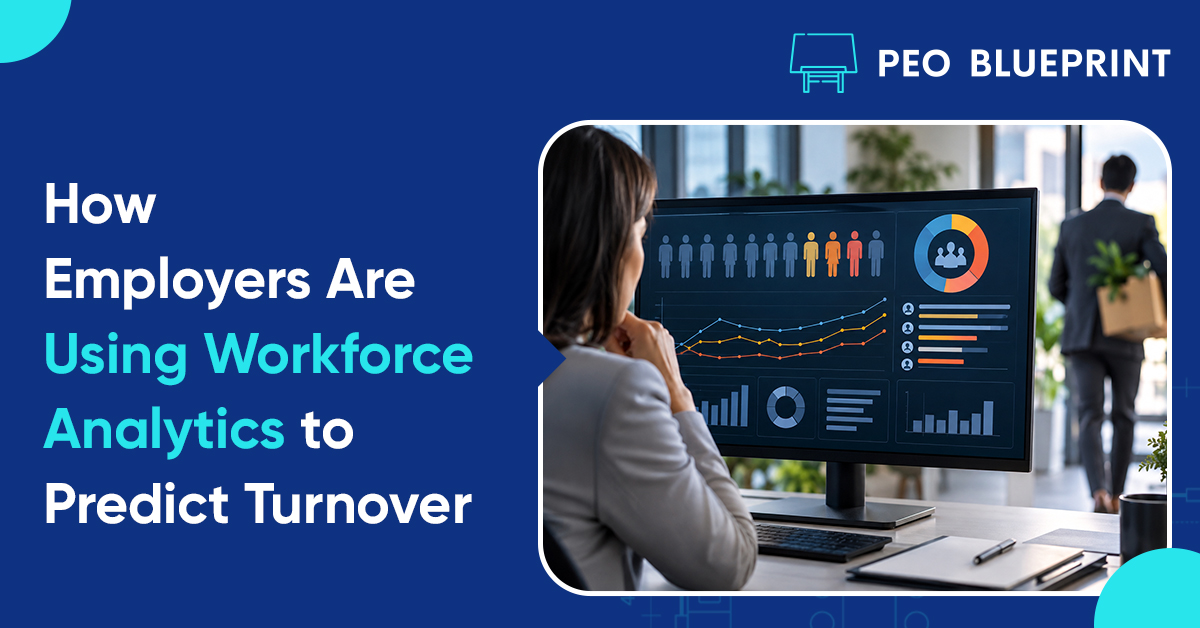
According to the National Association of Professional Employer Organizations (NAPEO), businesses that use PEOs grow 7–9% faster, have 10–14% lower employee turnover, and are 50% less likely to go out of business. Those are not administrative outcomes. Those are competitive outcomes — and they begin with a strategic mindset.
The Talent War Is Real — And PEOs Help You Win It
Access to Enterprise-Level Benefits Packages
Small and mid-sized companies face an inherent disadvantage when competing for top talent against large corporations. Enterprise employers can offer rich benefits packages — comprehensive health insurance, dental and vision coverage, 401(k) matching, mental health support, and flexible spending accounts — that smaller businesses cannot afford to replicate on their own. This gap in benefits quality often costs growing companies their best candidates.
A PEO strategy eliminates that disadvantage. Because PEOs pool employees across hundreds or thousands of client companies, they negotiate benefits at scale. This purchasing power allows even a 20-person company to offer a benefits package that rivals that of a 2,000-person corporation. Candidates choose employers who take care of their people, and a robust benefits offering signals exactly that.
✅ Offer health insurance options comparable to large corporations
✅ Provide 401(k) plans with employer matching that smaller firms rarely fund alone
✅ Include dental, vision, life, and disability coverage in competitive packages
✅ Add voluntary benefits like legal services, pet insurance, and employee assistance programs
✅ Present a polished, professionally administered onboarding benefits experience
Faster Hiring and Smoother Onboarding
Speed matters in recruiting. When a strong candidate receives multiple offers, the company that moves decisively — and professionally — wins. PEOs equip their client companies with streamlined onboarding technology, digital offer letter systems, automated new-hire paperwork, and compliance-ready documentation processes. This infrastructure enables companies to move from offer to first day faster than competitors that rely on manual HR workflows.
Onboarding quality also predicts retention. Research consistently shows that employees who experience a structured, welcoming onboarding process are significantly more likely to stay past their first year. By leveraging a PEO’s onboarding systems, companies create a strong first impression that pays dividends for months and years afterward.
Compliance as a Competitive Advantage
The Hidden Cost of Non-Compliance
Most business owners think about compliance defensively — as something to avoid rather than something to leverage. But in practice, the companies that manage compliance most effectively spend fewer resources on risk mitigation and more resources on growth. That imbalance compounds over time.
Employment law in the United States is extraordinarily complex and constantly changing. Federal, state, and local regulations govern everything from minimum wage and overtime rules to FMLA leave, ADA accommodations, COBRA administration, equal employment opportunity requirements, and workplace safety standards. For multi-state employers, the regulatory matrix becomes even more demanding. One missed deadline, one poorly worded policy, or one misclassified worker can trigger penalties, lawsuits, and reputational damage that far outweigh the cost of proper compliance infrastructure.
A proactive PEO strategy addresses this risk structurally. PEOs employ dedicated compliance specialists who monitor regulatory changes across all operating states and update HR policies, employee handbooks, and processes accordingly. Client companies benefit from that expertise without maintaining an in-house legal and HR compliance team.
Multi-State Expansion Without Multi-State Headaches
Geographic expansion is one of the clearest scenarios where a PEO strategy pays immediate dividends. When a company hires its first employee in a new state, it faces a thicket of new requirements:
- State income tax registration and withholding
- State unemployment insurance account setup
- State-specific paid leave laws
- Workers’ compensation coverage requirements
- State-level employment posters and disclosure requirements
- Local ordinances in major metro areas
Without a PEO, navigating this process requires time, legal fees, and significant HR bandwidth — all before the new employee contributes a single productive hour. With a PEO in place, the expansion becomes administratively seamless. The PEO already has an employer-of-record infrastructure across all 50 states. Companies can hire in new markets within days rather than months.
For businesses pursuing aggressive growth, this capability isn’t optional. It is a structural competitive advantage that enables speed-to-market that rivals cannot match.
Cost Efficiency That Funds Strategic Investment
Reducing the True Cost of HR
Many companies underestimate the true cost of their HR function. Beyond salary and benefits for HR staff, the full cost includes payroll software subscriptions, legal retainer fees, compliance training, workers’ compensation premiums, recruiting tools, background check platforms, and the time business owners and managers spend resolving HR issues that fall outside anyone’s defined job description.
When companies calculate the fully loaded cost and compare it to PEO fees, the math often tells a compelling story. PEOs achieve economies of scale across every one of those cost categories, and they pass a meaningful portion of those savings to client companies. The result is a lower total cost of HR administration — combined with a higher level of service and expertise.
✅ Lower workers’ compensation premiums through PEO group rates
✅ Eliminate or reduce the need for dedicated in-house HR generalists
✅ Access enterprise payroll platforms without enterprise licensing fees
✅ Reduce legal exposure and the cost of employment-related disputes
✅ Consolidate vendor relationships for HR, benefits, and payroll into one partner
Redirecting Savings Toward Revenue-Generating Activities
The financial efficiency of a PEO strategy is most powerful when the savings are deliberately reinvested into competitive initiatives. Companies that redirect freed-up capital and leadership bandwidth toward product development, sales, customer experience, or market expansion compound their advantage over time. Businesses that still manage HR manually are spending resources that growth-oriented competitors deploy strategically.
This is the compounding logic that makes PEO strategy a genuine differentiator rather than a simple cost reduction. Learn more about how leading companies structure this reallocation at PEO Blueprint.
How PEO Strategy Supports a Scalable Culture
Building People Infrastructure Before You Need It
One of the most common and costly mistakes fast-growing companies make is under-investing in people infrastructure during early growth phases. They hire quickly, skip formal HR processes, build ad hoc compensation structures, and patch together benefits as an afterthought. This approach feels efficient in the short term. It becomes a serious liability the moment the company reaches 50, 100, or 200 employees.
A well-structured PEO strategy solves this problem by providing enterprise-grade HR infrastructure from day one — regardless of company size. Companies do not have to wait until they can justify a full HR department to have professional HR systems, compliant policies, and well-managed benefits. They have those systems in place while they are still small, which means cultural and operational scaling happens on a clean foundation rather than a hastily assembled one.
Employee Experience as a Retention Strategy
Employee retention is one of the most undervalued drivers of profitability. The cost of replacing a single employee ranges from 50% to over 200% of their annual salary when recruiting, onboarding, training, and productivity ramp-up are factored in. High-turnover companies hemorrhage money invisibly through attrition — and they rarely attribute that loss accurately to its true source.
PEOs directly support retention in several measurable ways:
✅ Provide access to mental health benefits and employee assistance programs that reduce burnout.
✅ Deliver consistent payroll with no errors or delays, which is a foundational element of employee trust.
✅ Offer structured performance management tools and review frameworks.
✅ Administer FMLA, parental leave, and other life-event benefits professionally and compliantly.
✅ Create a benefits package robust enough to reduce the financial pressure that drives employees to competitor offers
When employees feel supported, compensated fairly, and professionally managed, they stay longer. That stability reduces turnover costs, builds institutional knowledge, and strengthens team culture in ways that directly impact customer outcomes and company performance.
The Data-Driven Case for PEO Strategy
What the Research Actually Shows
The competitive case for PEO strategy is not anecdotal. It is backed by consistent, large-scale research. The Society for Human Resource Management (SHRM) has documented that companies using PEOs report higher employee satisfaction scores, lower HR administrative costs, and stronger compliance outcomes than comparable companies managing HR internally.
NAPEO’s annual research consistently demonstrates that PEO clients experience:
- 7–9% faster annual revenue growth compared to non-PEO businesses
- 10–14% lower employee turnover rates across industries
- Significantly reduced exposure to employment-related legal claims
- Higher employee benefits satisfaction scores
- Greater CEO confidence in compliance and HR management
These outcomes do not happen accidentally. They are the result of better infrastructure, deeper expertise, and a more intentional approach to human capital management — all of which a strong PEO strategy delivers systematically.
ROI That Goes Beyond Cost Savings
Return on investment from a PEO partnership should be measured across multiple dimensions. The most obvious dimension is direct cost savings — reduced benefits premiums, lower workers’ compensation costs, and reduced HR staffing expenses. But the complete ROI picture is much broader.
- Time ROI: Hours reclaimed by executives and managers who previously handled HR issues are now redirected to revenue-generating activities
- Talent ROI: Improved offer acceptance rates and candidate quality driven by better benefits and faster hiring processes
- Retention ROI: Lower turnover costs, stronger team continuity, and reduced recruiting burden
- Compliance ROI: Avoided penalties, reduced legal fees, and eliminated regulatory exposure
- Growth ROI: Faster geographic expansion, cleaner scaling infrastructure, and reduced friction when entering new markets
For a detailed breakdown of how to calculate the full ROI of a PEO partnership for your specific business context, explore the resources available at PEO Blueprint.
Industry-Specific Applications of PEO Strategy
Technology and SaaS Companies
Tech companies face some of the most intense talent competition in the economy. Engineers, product managers, and data scientists receive multiple offers simultaneously, and benefits packages are often a deciding factor in candidate decisions. A strong PEO strategy enables early-stage and growth-stage tech companies to offer competitive compensation packages, administer equity and benefits compliantly, and onboard remote employees across multiple states without building complex, multi-state HR infrastructure internally.
Additionally, tech companies that operate globally often use PEOs to manage domestic employment while they build out more sophisticated global employer-of-record arrangements. The domestic PEO relationship serves as a stable foundation for that expansion.
Healthcare and Professional Services
Healthcare organizations and professional services firms operate in heavily regulated environments where compliance is not optional. Nurse staffing agencies, therapy practices, medical billing firms, and consulting organizations all face complex licensing, credentialing, and employment law requirements that consume significant administrative bandwidth.
PEOs with healthcare industry expertise provide specialized compliance support, benefits administration that meets industry standards, and HR systems that accommodate the unique scheduling and credentialing needs of clinical and professional environments. For these businesses, a PEO strategy is not just about efficiency — it is about managing risk in an environment where non-compliance carries serious consequences.
Manufacturing and Construction
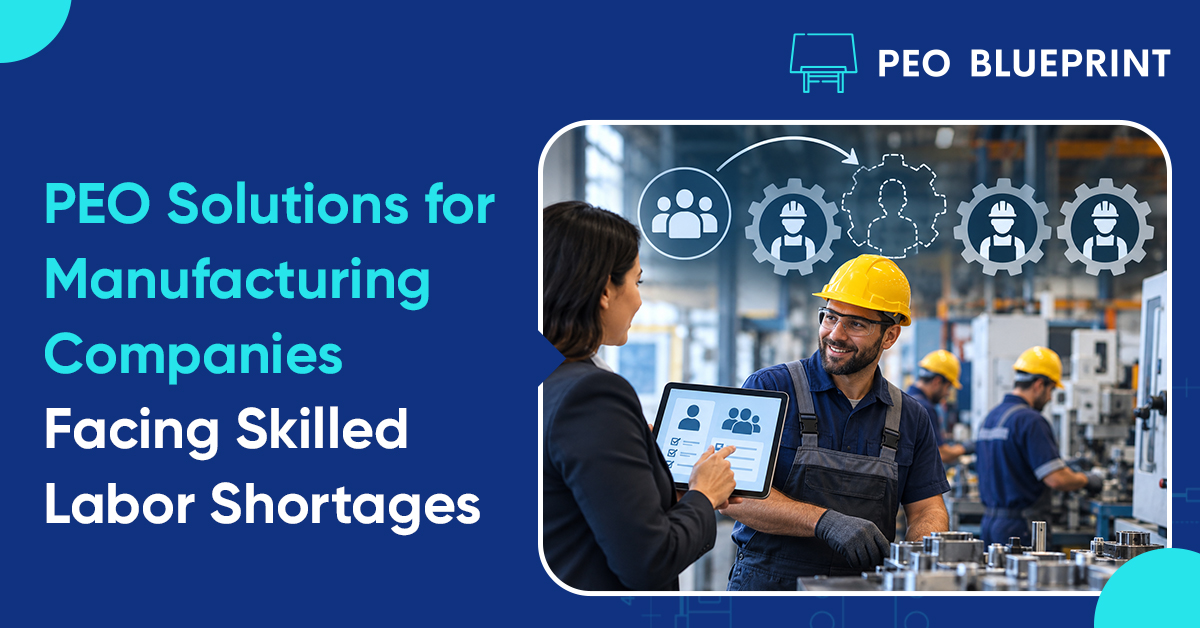
Industries with high workers’ compensation risk benefit disproportionately from PEO relationships. Manufacturing and construction companies often face workers’ compensation premiums that represent a substantial percentage of payroll. PEOs pool risk across client companies and negotiate rates that individual businesses cannot access on their own.
Beyond workers’ compensation, PEOs in these industries help manage OSHA compliance, safety training documentation, and injury reporting processes. These capabilities reduce both the frequency and cost of workplace incidents — protecting employees and the company’s bottom line simultaneously.
What to Look for When Building Your PEO Strategy
Choosing the right PEO partner is as important as the decision to use one. Not all PEOs are created equal, and a poorly chosen partner can create more problems than it solves. Forward-thinking companies evaluate PEO partners across several critical dimensions before committing.
Key Criteria for PEO Partner Selection
✅ ESAC or IRS certification — Look for PEOs certified by the Employer Services Assurance Corporation or recognized as Certified PEOs (CPEOs) by the IRS, which indicates financial stability and operational reliability
✅ Industry experience — Choose a PEO with demonstrated expertise in your specific industry’s regulatory and HR environment
✅ Technology platform quality — Evaluate the employee self-service portal, payroll dashboard, benefits enrollment system, and HR document management tools
✅ Dedicated service model — Distinguish between PEOs that assign a dedicated account team versus those that route all inquiries through a generalized call center
✅ Transparent pricing — Understand exactly how fees are structured — whether as a percentage of payroll or per-employee-per-month — and what services are included versus billed separately
✅ Scalability — Confirm that the PEO can support your growth trajectory, including multi-state hiring, international expansion, and rapid headcount increases
✅ References and case studies — Request references from companies in your industry and size range who can speak to their real-world experience with the PEO
Common Implementation Mistakes to Avoid
Even the best PEO strategy can underperform if implemented carelessly. Companies that treat the transition as purely an IT or payroll migration miss the cultural and strategic dimensions that drive long-term value.
- Failing to communicate the transition to employees clearly — Employees need to understand why the company is making this change and what it means for their benefits and day-to-day experience.
- Not aligning PEO services with strategic growth plans — The PEO should understand your three-year growth roadmap so they can proactively support multi-state hiring, headcount scaling, and benefits evolution.
- Underutilizing available HR resources — Many companies pay for PEO services and then continue to manage HR issues manually because they are unaware of all the tools and expertise available to them.
- Choosing on price alone — The cheapest PEO option is rarely the most strategic one; total value across compliance support, technology quality, and service depth matters far more than headline fees
Integrating PEO Strategy With Broader Business Strategy
The companies that extract the most value from their PEO partnerships do not treat the relationship as separate from their overall business strategy. They integrate it intentionally.
Executive teams that think strategically about HR use their PEO partner as a sounding board for workforce planning, compensation benchmarking, and benefits optimization. They review HR analytics dashboards quarterly alongside financial metrics. They tap PEO compliance specialists proactively before entering new markets rather than reactively after encountering regulatory issues.
This level of integration transforms the PEO relationship from a vendor arrangement into a genuine strategic partnership. The PEO becomes part of the company’s extended leadership team, providing expertise, infrastructure, and insight that would otherwise require a much larger internal team to replicate.
For growing businesses that want to compete against larger rivals without the overhead of a large enterprise HR department, this is the real promise of a well-executed PEO strategy: enterprise capability at a fraction of the cost, delivered through a partnership designed to scale with your ambitions.
Explore how to build this kind of strategic HR foundation for your business at PEO Blueprint.
Conclusion: PEO Strategy Is a Decision About the Kind of Company You Want to Build
Every business decision ultimately reflects a set of priorities. Companies that invest in a deliberate PEO strategy are making a clear statement: they prioritize talent, operational excellence, compliance, and scalable growth over administrative familiarity and short-term cost minimization.
The competitive advantages that flow from this decision are not marginal. They compound. Better talent leads to better products and better customer experiences. Lower turnover reduces costs and builds institutional knowledge. Compliance confidence enables bold geographic expansion. Reclaimed executive bandwidth drives faster strategic decision-making.
Forward-thinking companies do not wait until HR dysfunction forces a change. They build the right infrastructure early, align it with their growth ambitions, and use it as a platform for consistent competitive performance. In a business environment where talent, agility, and operational efficiency increasingly determine which companies win and which ones struggle, a strong PEO strategy is not a luxury. This is essential for any organization serious about long-term success.