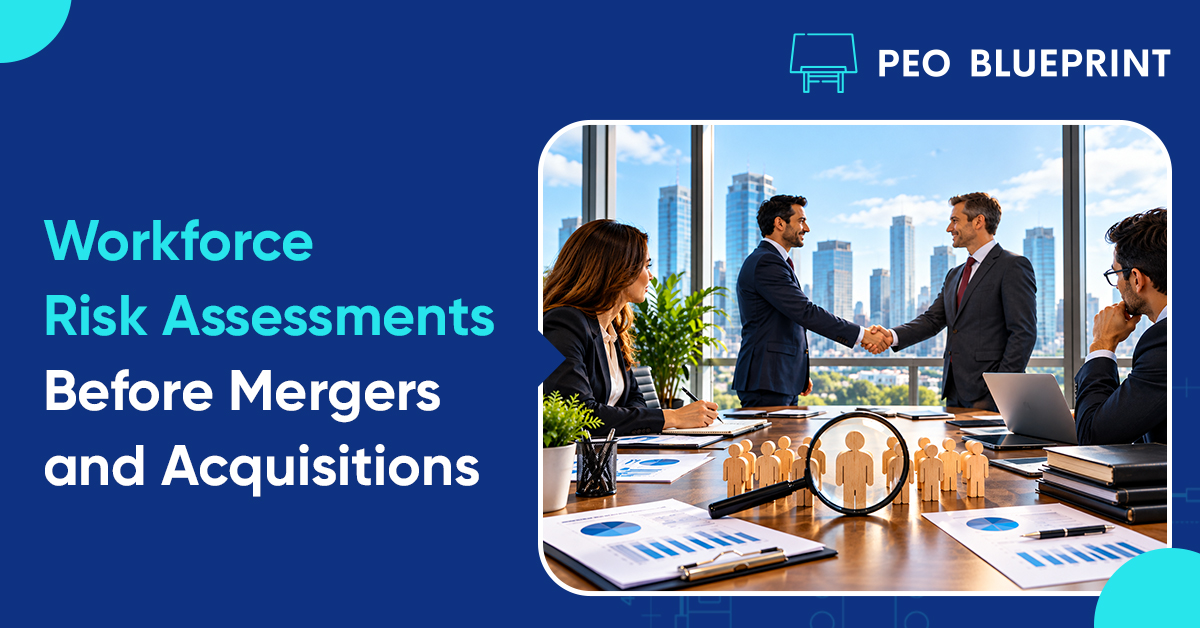
Mergers and acquisitions can create rapid growth, new capabilities, and stronger market positions, but they also introduce significant people-related risks. Financial models often receive the most attention during due diligence, while workforce issues can remain scattered across payroll, benefits, contracts, policies, and employee records. Workforce Risk Assessments bring those issues into one structured review before the transaction closes. They help buyers understand what they are inheriting, help sellers disclose material concerns, and give leadership a practical roadmap for integration.
A workforce review should examine compensation, benefits, employment practices, workforce structure, compliance, talent concentration, and organizational culture. It should also identify obligations that may survive closing. When leaders understand these factors early, they can price risks more accurately, negotiate protections, and prepare employees for change.
Why Workforce Risk Assessments Matter in M&A
Every acquisition transfers more than assets, customers, technology, and revenue. It can also transfer employment obligations, benefit commitments, unresolved disputes, payroll practices, and workforce expectations. A workforce due diligence process makes those liabilities visible before they become integration problems.
An organization may appear efficient on paper but carry hidden people costs. Examples include unused paid time off, bonus commitments, misclassified workers, inconsistent compensation, underfunded benefit obligations, or employment agreements with change-in-control provisions. A buyer that discovers these issues after closing has fewer options and less leverage.
What a Workforce Risk Assessment Covers
A strong M&A assessment begins with a Workforce Risk Assessment. A strong assessment reviews the complete employment lifecycle rather than focusing only on headcount. The objective is to understand how people are hired, paid, managed, protected, rewarded, and retained.
Key review areas include:
• Employee census and organizational structure
• Compensation, commissions, bonuses, and incentives
• Payroll processes and wage-and-hour practices
• Employee benefits and retirement plans
• Employment agreements and restrictive covenants
• Independent contractor classification
• Immigration and work authorization records
• Workplace policies and employee handbooks
• Pending claims, complaints, investigations, and litigation
• Turnover, absenteeism, and workforce stability
• Critical roles and key-person dependency
• Talent acquisition and retention programs
• Leave practices and accrued obligations
• Human resources technology and data quality
• Culture, leadership structure, and employee engagement
The scope should reflect the size, industry, geography, and transaction structure. A multinational acquisition needs a broader review than a small domestic asset purchase, but smaller deals still deserve disciplined workforce due diligence.
1. Build an Accurate Workforce Baseline
The first step is creating a reliable workforce baseline. Leadership should know exactly who works for the organization, where employees work, what they earn, what benefits they receive, and how their employment relationships are documented.
Workforce Risk Assessments should start with the employee census and reconcile it against payroll and HR records. Differences can reveal inactive employees, missing records, inconsistent classifications, or data-quality problems. The review should also distinguish full-time employees, part-time employees, temporary workers, consultants, and independent contractors.
A complete baseline should capture job title, department, location, hire date, employment status, compensation, variable pay, benefits eligibility, reporting relationship, and employment agreement status. It should also identify employees on leave and roles that are difficult to replace.
Clean workforce data supports better financial modeling. If payroll records show one headcount while HR records show another, the buyer cannot confidently estimate future labor costs.
2. Review Compensation and Payroll Practices
Compensation can create both immediate costs and long-term integration challenges. Buyers should review base pay, overtime, commissions, bonuses, equity, allowances, severance commitments, and deferred compensation.
Look for employees whose compensation differs materially from peers performing comparable work. The difference may be legitimate, but unexplained disparities deserve review because integration can quickly expose them. A new compensation structure may also create retention problems if employees perceive the change as unfair.
Payroll controls require similar attention. Review pay frequency, timekeeping, overtime practices, payroll taxes, deductions, and final-pay procedures. The U.S. Department of Labor explains that worker classification under the Fair Labor Standards Act depends on the economic realities of the relationship, making classification an important due-diligence issue.
Potential red flags include:
• Employees regularly working beyond scheduled hours without appropriate overtime treatment
• Manual timekeeping with weak approval controls
• Commission plans that lack clear payment terms
• Unresolved payroll corrections or wage claims
• Different pay practices across locations without documented reasons
• Independent contractors performing roles that resemble employee positions
These issues can create financial exposure and operational friction after closing.
3. Examine Employee Benefits and Retirement Plans
Benefits often represent a substantial portion of total employee cost. A transaction can require careful coordination of health insurance, retirement plans, paid leave, disability coverage, life insurance, flexible spending accounts, and other programs.
Workforce Risk Assessments should review plan documents, eligibility rules, employer contributions, employee contributions, renewal terms, outstanding claims information where appropriate, and administrative practices. Compare the target company’s programs with the buyer’s programs to estimate integration costs.
Retirement plans deserve special attention. The IRS notes that a merger can result in a new plan sponsor, a plan merger, or termination of one or both retirement plans. Each structure can create different administrative and compliance requirements.
Benefit due diligence should answer practical questions:
• Which plans will continue after closing?
• Which employees will become eligible for buyer-sponsored plans?
• Will contribution levels change?
• Are there outstanding plan amendments or compliance matters?
• How will service credit and vesting be handled?
• Could plan changes affect retention?
• What employee communications are required?
The IRS also identifies documentation as an important consideration in mergers, including plan documents and amendments. Missing records can slow integration and complicate compliance review.
4. Investigate Employment Agreements and Obligations
Workforce Risk Assessments should flag employment agreements that can materially affect an acquisition. Review executive agreements, offer letters, retention arrangements, severance plans, commission agreements, confidentiality provisions, intellectual property assignments, and restrictive covenants.
Pay particular attention to change-in-control clauses. These provisions may trigger severance, accelerated vesting, bonuses, or other benefits when ownership changes. A transaction model that ignores those obligations can understate total deal costs.
The review should also identify agreements that could limit the buyer’s ability to reorganize the workforce. Some employees may have contractual protections, guaranteed compensation periods, or notice requirements.
Legal counsel should evaluate enforceability because employment rules vary by jurisdiction. The goal of the workforce review is not to replace legal advice, but to identify documents and facts that require legal analysis before signing or closing.
5. Assess Worker Classification Risk
Workforce Risk Assessments must examine worker classification because it remains a major due diligence issue. Organizations frequently use contractors, consultants, temporary workers, and other nontraditional arrangements.
Review how each nonemployee relationship operates in practice. Examine the individual’s duties, independence, payment structure, schedule, supervision, tools, duration, and relationship with the business. A contract label alone does not necessarily determine legal classification.
The Department of Labor states that FLSA employee status is evaluated using the economic realities of the relationship. This makes operational facts essential to the review.
Classification risks can include:
• Back wages and overtime exposure
• Payroll tax issues
• Benefit eligibility disputes
• Penalties and interest
• Misclassification claims
• Disruption when contractors are converted to employees
Buyers should quantify potential exposure where possible and determine whether indemnities, escrow arrangements, or purchase-price adjustments deserve consideration.
6. Review Employment Compliance
Workforce Risk Assessments should apply the same discipline to employment compliance as financial and operational diligence. Review policies, required notices, workplace practices, wage-and-hour procedures, leave administration, accommodation processes, anti-discrimination controls, harassment reporting, and employee recordkeeping.
Investigate known complaints, agency charges, lawsuits, settlements, demand letters, and internal investigations. Determine whether any matter could continue after closing or create successor liability.
The EEOC explains that, in certain circumstances, an acquiring business can face liability for employment discrimination by a predecessor. That makes historical employment practices relevant to transaction risk, not merely the target’s current policies.
Background-check processes also deserve review. The EEOC notes that employers must comply with federal nondiscrimination requirements when using background information, alongside other applicable rules. A target’s process should therefore be examined for consistency, documentation, and legal compliance.
7. Identify Key Talent and Retention Risk
Workforce Risk Assessments should also examine talent because a deal can fail to deliver its expected value even when the financial model is sound if critical employees leave after closing. Workforce Risk Assessments should therefore examine not only legal exposure but also talent continuity.
Identify employees who control important customer relationships, technical knowledge, operational processes, intellectual property, or institutional history. Determine whether the organization depends heavily on a small number of individuals.
Review:
• Voluntary turnover trends
• Regrettable turnover
• Tenure by department
• Open critical positions
• Employee engagement indicators
• Leadership succession coverage
• Compensation competitiveness
• Retention bonuses and agreements
• Key-person dependency
A retention strategy should focus on business-critical roles rather than automatically offering incentives to everyone. Clear communication, career visibility, stable reporting lines, and timely answers can also influence retention.
8. Evaluate Organizational Culture
Workforce Risk Assessments should include culture because culture is harder to measure than payroll, but it can directly affect integration. Two organizations may have similar financial profiles while operating with very different expectations around decision-making, communication, flexibility, hierarchy, and performance.
Assess how leaders communicate, how managers make decisions, how employees receive feedback, and how teams collaborate. Look for evidence of cultural friction that could become more visible after the announcement.
Useful indicators include employee surveys, turnover patterns, exit interviews, grievance data, management interviews, and workplace policies. Avoid treating culture as a vague label. Convert observations into specific integration risks.
For example, a highly centralized company acquiring a decentralized organization may create uncertainty if employees suddenly lose decision-making authority. A remote-first workforce may also react differently to a return-to-office requirement than an organization built around physical offices.
9. Analyze Workforce Cost and Synergy Assumptions
Workforce Risk Assessments should test synergy assumptions because M&A models often include labor synergies. Those assumptions require careful workforce analysis before management relies on them.
Separate realistic savings from theoretical reductions. A department may appear to have duplicate positions, but eliminating those roles can affect service levels, compliance, customer relationships, or institutional knowledge. Severance, recruiting, retention, training, and technology costs can also reduce the near-term value of projected savings.
Build a workforce cost model that includes:
• Current payroll
• Employer payroll taxes
• Benefits and retirement contributions
• Bonuses and commissions
• Paid leave liabilities
• Severance assumptions
• Expected salary adjustments
• Integration costs
• Recruiting and replacement costs
• Retention incentives
A disciplined model helps leaders understand both the cost of action and the cost of inaction.
10. Create a Workforce Risk Register
Workforce Risk Assessments become more useful when findings move into a structured risk register. Each issue should have a clear description, owner, financial estimate, severity, timing, and proposed response.
A practical register can classify findings as critical, high, moderate, or low based on the organization’s own risk methodology. Avoid relying on labels alone. Explain what makes an issue material and what could happen if leadership takes no action.
Each finding should answer five questions:
What is the issue?
What evidence supports it?
What is the potential financial, legal, or operational impact?
Who owns the response?
What must happen before or after closing?
Common Red Flags in Workforce Due Diligence
Workforce Risk Assessments should investigate certain patterns that can trigger deeper investigation. None automatically means a transaction should stop, but each can affect valuation, integration, or post-close risk.
• Large unexplained differences between HR and payroll headcount
• High turnover concentrated in critical departments
• Significant reliance on independent contractors
• Missing employment agreements or benefit documents
• Repeated wage-and-hour complaints
• Unresolved employee grievances
• Heavy dependence on one executive or technical expert
• Large unused paid-time-off balances
• Inconsistent compensation practices
• Retention problems following earlier organizational changes
• Weak HR recordkeeping
• Unclear responsibility for employment compliance
The important point is to investigate patterns rather than isolated anomalies. A single unusual record may be harmless; repeated inconsistencies may indicate a systemic control problem.
How to Conduct Workforce Risk Assessments Before Closing
Workforce Risk Assessments work best when a repeatable process improves speed and consistency. The following sequence works well for many transactions.
Define the scope. Identify entities, jurisdictions, employee populations, benefit programs, contractors, and transaction assumptions.
Request the data. Build a secure data room containing census files, payroll reports, policies, agreements, benefits documents, claims information, and relevant HR records.
Validate the data. Reconcile employee, payroll, benefits, and organizational information. Document gaps rather than fill them with assumptions.
Assess compliance. Review wage-and-hour practices, worker classification, employment policies, leave practices, discrimination risks, and other applicable requirements.
Model financial exposure. Quantify compensation commitments, benefit costs, severance, liabilities, retention expenses, and integration costs.
Identify critical talent. Map key roles, succession gaps, retention risks, and dependencies.
Build the risk register. Rank findings using documented criteria and assign accountable owners.
Connect findings to the transaction. Determine which risks affect price, representations and warranties, indemnities, escrow, closing conditions, or integration planning.
Prepare the Day One plan. Decide what employees need to know, which systems must change, and which benefits or policies require immediate action.
Track post-close remediation. Continue monitoring unresolved risks until responsible leaders confirm completion.
This process creates continuity between diligence and integration. It also prevents important workforce findings from disappearing after the deal closes.
The Role of a PEO in M&A Workforce Planning
A professional employer organization can provide valuable support when a growing company needs stronger HR infrastructure before, during, or after a transaction. A PEO can help centralize HR administration, payroll, benefits coordination, compliance support, and workforce processes.
Organizations exploring this model can review PEO solutions and HR outsourcing resources to understand how an external partner may support workforce operations. The right structure depends on the company’s size, transaction strategy, workforce complexity, and compliance needs.
PEO support can be particularly useful when the target company has limited internal HR capacity. It can also help establish more consistent processes during periods of rapid growth, although transaction-specific legal and tax advice should remain with qualified professionals.
Using Workforce Risk Assessments to Improve Integration
Workforce Risk Assessments are strongest when they do more than identify problems. The best assessments help management prepare for the human side of integration.
Workforce Risk Assessments should translate each material finding into an action. If compensation differs significantly, establish a pay-alignment plan. If benefit programs conflict, create a transition timeline. If key employees face retention risk, develop targeted retention and communication strategies.
Internal communication should also be deliberate. Employees want clear answers about reporting lines, compensation, benefits, work location, job security, and career opportunities. Silence creates room for speculation, while inconsistent messages can damage trust.
A detailed integration plan should include:
• Day One responsibilities
• HR system migration
• Payroll transition
• Benefits enrollment
• Policy harmonization
• Manager communication
• Employee communications
• Retention actions
• Compliance remediation
• Workforce reporting
Integration should begin during diligence, not after the transaction closes.
How Buyers and Sellers Can Work Together
Workforce Risk Assessments help buyers and sellers work together because buyers need reliable information, while sellers need a process that protects confidentiality and business continuity. Both sides benefit when workforce diligence follows a structured data request and clearly defined review period.
Sellers should organize employment records before launching a transaction process. Buyers should avoid requesting excessive information without a clear purpose. Both parties should use appropriate confidentiality controls, especially when sensitive employee information is involved.
A clean diligence process can reduce transaction delays and improve trust between deal teams. It also helps advisors focus attention on material issues instead of spending time resolving preventable documentation gaps.
Final Checklist for Workforce Due Diligence
Before closing, Workforce Risk Assessments should enable leadership to answer several practical questions.
✅ Do we know the true employee and contractor population?
✅ Have we reconciled workforce data with payroll and benefits records?
✅ Have we identified material compensation and severance commitments?
✅ Have we reviewed retirement and benefit plan obligations?
✅ Have we assessed worker classification?
✅ Have we reviewed employment agreements and restrictive covenants?
✅ Have we investigated claims, complaints, and regulatory matters?
✅ Have we identified critical employees and retention risks?
✅ Have we modeled workforce integration costs?
✅ Does every material finding have an owner and remediation plan?
If several answers are unclear, these Workforce Risk Assessments are not complete. Additional diligence may protect the buyer from surprises and help both parties establish realistic expectations.
Why Workforce Risk Assessments Should Start Early
Timing matters in M&A, so Workforce Risk Assessments should begin early. Early preparation protects long-term transaction value.
Early Workforce Risk Assessments give deal teams time to investigate discrepancies, validate financial assumptions, consult legal specialists, and prepare employee communications. They also create a factual foundation for integration planning.
The most effective Workforce Risk Assessments treat people as a core transaction asset and risk category. Workforce diligence is not simply an HR exercise; it connects legal compliance, financial planning, operational continuity, and employee experience.
For organizations evaluating HR infrastructure, Workforce Risk Assessments can also inform decisions about professional employer organization models and workforce support strategies. PEO Blueprint can serve as a resource for understanding professional employer organization models and workforce support strategies.
Conclusion
Mergers and acquisitions create growth opportunities, but the workforce can determine whether those opportunities translate into sustainable results. Workforce Risk Assessments help leaders uncover employment liabilities, benefit obligations, talent dependencies, compliance gaps, and integration costs before they become expensive surprises.
A disciplined review should combine accurate workforce data, employment compliance, compensation analysis, benefits diligence, worker classification, talent assessment, culture review, and financial modeling. It should then convert findings into clear actions, owners, and timelines.
The objective is not to eliminate every workforce difference before closing. The objective is to understand the risks, quantify their potential impact, protect the transaction, and prepare the combined organization for a stable transition.
When workforce diligence starts early and continues through integration, buyers and sellers can make better-informed decisions, reduce avoidable disruption, and build a stronger foundation for the next stage of growth.