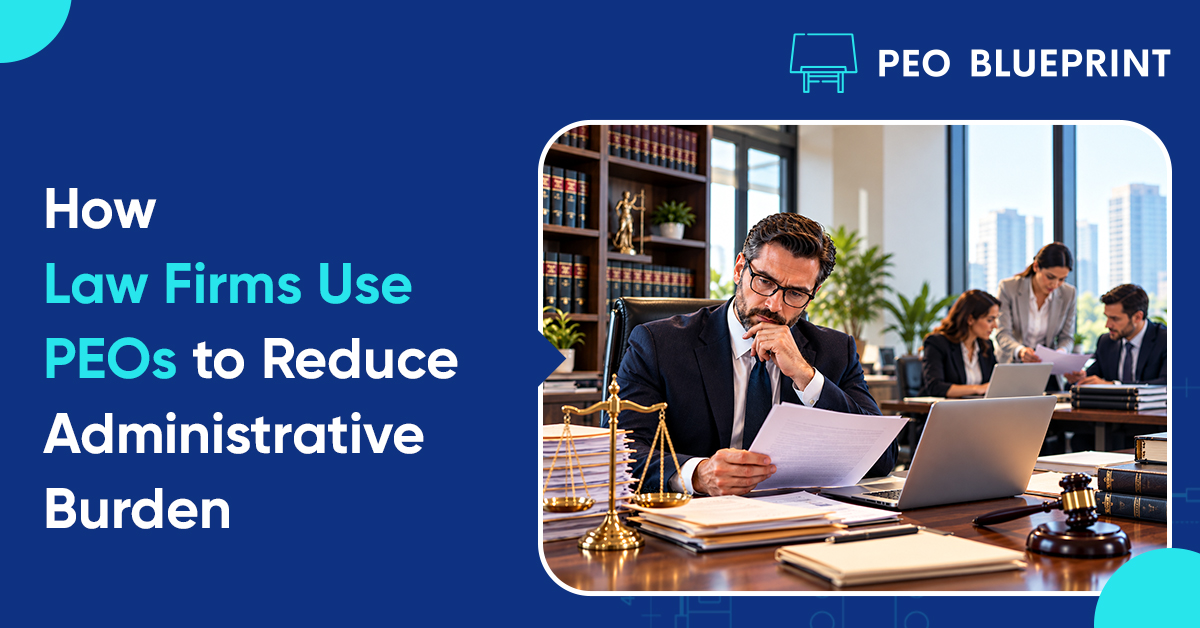
Law firms operate in a high-pressure environment where deadlines, client demands, billable hours, and professional standards leave little room for administrative distractions. Yet every growing firm must manage payroll, employee records, benefits, hiring, onboarding, workplace policies, and employment compliance. Law Firms Use PEOs to shift much of that operational workload to a specialized partner, allowing attorneys and firm leaders to focus more consistently on legal work and business development.
A professional employer organization, or PEO, provides outsourced HR services through a co-employment model. Depending on the agreement, a PEO can support payroll administration, employee benefits, HR technology, workers’ compensation, recruiting, risk management, and compliance processes. The goal is not to replace a law firm’s leadership. Instead, it gives the firm an experienced administrative infrastructure without requiring a large internal HR department.
For law firms with demanding workloads, that distinction matters. Administrative work may appear manageable when a firm has only a few employees, but complexity rises quickly as headcount, locations, compensation structures, and benefit needs expand. A PEO can help create repeatable processes that reduce manual work and improve operational consistency.
Why Administrative Work Becomes Difficult for Law Firms
Law firms have a unique operating model. Attorneys may handle client matters, court appearances, negotiations, research, and business development, while partners also manage budgets, staffing, and firm strategy. Office managers, bookkeepers, partners, or a small operations team often handle administrative responsibilities.
That structure can create hidden costs. When experienced professionals spend time correcting payroll information, answering routine HR questions, comparing benefit options, or managing employee documentation, the firm loses time it could use to support clients or revenue-producing activities.
Employment administration also involves multiple moving parts. Employers generally must withhold and report federal employment taxes, including federal income tax, Social Security, Medicare, and federal unemployment tax. The IRS also requires employers to meet reporting and deposit obligations on applicable schedules.
The U.S. Department of Labor also requires covered employers to maintain accurate records related to wages, hours, and other employment information under the Fair Labor Standards Act. Recordkeeping is only one part of a broader HR responsibility that can include hiring documents, leave administration, workplace policies, benefits, and employee relations.
For a law firm, administrative complexity can therefore become a business issue rather than a simple back-office inconvenience.
How Law Firms Use PEOs for Daily HR Administration
Law firms typically use PEOs to centralize recurring employment processes. Instead of managing every task through disconnected systems, firm leadership can work with one HR partner and one technology platform for many core functions.
The exact services vary by provider and contract, but common areas include:
• Payroll processing and payroll administration
• Employee onboarding and HR documentation
• Benefits administration and employee support
• Workers’ compensation administration
• HR technology and employee self-service
• Compliance support and policy guidance
• Recruiting and talent management
• Training and workplace development
• Risk management and safety resources
This centralized structure can reduce administrative handoffs within the firm. Employees may also gain a clearer process for routine questions about benefits, payroll, policies, and HR procedures.
A firm should still understand its responsibilities under the applicable agreement. A PEO does not mean that attorneys or managing partners can ignore employment obligations. The arrangement should clearly define responsibilities, authority, compliance processes, data access, and escalation procedures.
1. Payroll Administration Becomes More Structured
Payroll is one of the most repetitive and deadline-sensitive functions in any organization. Law firms may have salaried attorneys, hourly staff, part-time employees, bonuses, commissions, reimbursements, and other compensation arrangements. Managing these details manually can create unnecessary administrative work.
A PEO can provide a centralized payroll process that handles recurring calculations, payroll schedules, employee changes, tax administration, and reporting support. Employees can often access pay information through an online portal, reducing routine questions directed to office staff.
The IRS notes that employers must withhold and report employment taxes, including federal income tax, Social Security, Medicare, and FUTA taxes. Outsourcing payroll administration can help firms establish a more consistent process for completing these recurring tasks, although the specific allocation of tax responsibilities depends on the PEO arrangement.
The practical benefit is less manual coordination. Instead of maintaining separate spreadsheets, payroll records, and disconnected employee files, the firm can use a structured system that brings core information together.
2. Benefits Administration Can Become Easier
Employee benefits can be a major administrative challenge for growing law firms. Partners may want to offer competitive health coverage, retirement plans, dental and vision benefits, life insurance, or other voluntary benefits. At the same time, employees expect clear answers and smooth enrollment.
PEOs can provide access to benefits administration and, in some arrangements, group purchasing structures that may give smaller employers access to broader benefit options. Availability, pricing, plan design, eligibility, and participation rules vary by provider and state, so firms should evaluate the actual offering rather than assume every PEO provides the same benefits.
A centralized benefits system can reduce manual work related to enrollment, employee changes, documentation, and routine questions.
Benefits support can also improve the employee experience. When employees can review plan information, update elections, and access resources through one system, administrative friction can decrease.
3. Hiring and Onboarding Become More Consistent
Law firms need qualified attorneys, paralegals, legal assistants, reception staff, technology professionals, and other employees. Hiring the right people matters, but onboarding them efficiently matters just as much.
A PEO solution can support standardized onboarding workflows that organize required forms, policy acknowledgments, payroll setup, benefits enrollment, and employee records. This creates a repeatable process that doesn’t depend on one office administrator remembering every step.
A structured onboarding process can also help new employees understand workplace expectations faster. Firms can establish consistent procedures for technology access, confidentiality requirements, workplace policies, benefits, and administrative contacts.
The result is a smoother transition from accepted offer to productive employee.
4. HR Compliance Support Helps Reduce Administrative Risk
Employment regulations can change, and requirements may differ by jurisdiction. A law firm may have sophisticated legal expertise but still needs specialized HR knowledge to apply employment rules. in practice
A PEO can provide HR professionals, compliance resources, policy support, and technology designed around employment administration. This can help firms identify routine HR requirements and create consistent processes.
However, PEO support should not be treated as a substitute for legal advice. A firm should determine when a matter requires its own employment counsel, particularly for complex disputes, litigation, regulatory interpretation, or jurisdiction-specific legal questions. A PEO’s value is operational support. It can help create systems and processes that make compliance work more manageable while allowing the firm to retain appropriate legal oversight.
5. Employee Records Become More Organized
Employee records can become difficult to manage when information is stored across email accounts, spreadsheets, paper files, and unrelated software. A centralized HR platform can provide an organized approach.
PEO technology may bring together employee profiles, payroll information, benefits data, onboarding documents, and other HR records. Access controls can help limit sensitive information to authorized users.
The Department of Labor emphasizes the importance of accurate employment records. DOL recordkeeping guidance: A structured system can make it easier to maintain consistent information and retrieve records when needed.
Law firms should also evaluate data security, retention, access permissions, integrations, and privacy practices before selecting a PEO. Legal organizations routinely handle sensitive information, so HR technology should meet the firm’s operational and security expectations.
6. Workers’ Compensation Administration Can Be Centralized
Workers’ compensation is another area that requires administrative coordination. Firms must manage coverage, employee information, claims, documentation, and related communications according to applicable requirements.
A PEO may provide workers’ compensation administration and support with claims processes. Centralizing these activities can reduce the burden on office managers and partners who may not handle employment administration every day.
Before signing an agreement, the firm should review the PEO’s coverage structure, claims process, pricing, state availability, and responsibilities. The right arrangement depends on the firm’s workforce, locations, risk profile, and operational needs.
7. Law Firms Can Improve HR Technology Without Building It Internally
Building an internal HR infrastructure can require software, implementation time, training, maintenance, and specialized staff. Smaller and midsize law firms may not want to make that investment while focusing on serving clients.
A PEO partner can provide scalable systems for payroll, HR records, benefits, onboarding, and employee support. This can help a growing firm maintain consistent processes without immediately building a large internal HR department.
Technology alone does not solve HR problems. The firm should evaluate usability, integration capabilities, reporting, mobile access, data security, customer support, and implementation quality.
A useful starting point is to review the firm’s existing administrative workflow and identify where duplication occurs. If the same employee information is entered into multiple systems, that strongly signals that process consolidation could create value.
8. PEOs Can Support Employee Retention
Law firms compete for talented professionals. Compensation matters, but employees also pay attention to benefits, onboarding, communication, workplace policies, career development, and the overall employee experience.
PEO services can support these areas by giving smaller firms access to structured HR programs and benefits administration. Some providers also offer employee assistance programs, training resources, performance management tools, and other workplace services.
These resources do not guarantee retention. However, they can help firms build a more consistent employment experience.
For partners, the strategic advantage is visibility. Instead of reacting to every HR issue individually, leadership can use structured processes and data to identify recurring employee concerns and operational gaps.
9. Administrative Efficiency Can Protect Billable Time
Time is especially valuable in a professional services business. Every hour spent on administrative work is an hour that an attorney or senior professional cannot spend on client matters, business development, mentoring, or firm strategy.
PEOs can reduce some recurring administrative activities by consolidating payroll, benefits, onboarding, HR support, and related workflows.
The financial impact depends on the firm’s size, internal staffing, service scope, and PEO fees. A responsible analysis should compare the total cost of the current process with the total cost of the proposed arrangement, including both direct and indirect costs.
A firm can evaluate:
• Hours spent each month on payroll and HR tasks
• Administrative errors and corrections
• Time spent answering employee questions
• Internal HR staffing costs
• Software subscriptions and maintenance
• Benefits administration workload
• Compliance tracking and documentation
• Recruiting and onboarding effort
This approach helps partners evaluate a PEO as an operational investment rather than simply another vendor expense.
10. PEOs Can Help Growing Firms Scale
Growth creates administrative complexity. A firm that moves from 10 employees to 30 or from one location to several may discover that informal processes no longer work.
A PEO can provide scalable systems for payroll, HR records, benefits, onboarding, and employee support. This can help a growing firm maintain consistent processes without immediately building a large internal HR department.
Scalability becomes especially important when firms expand into new states. Employment requirements can vary by jurisdiction, making centralized HR support more valuable as geographic complexity increases.
Firms should confirm exactly what multi-state support a PEO provides. State availability, benefits, workers’ compensation, tax handling, and compliance services can differ significantly among providers.
How Law Firms Use PEOs Without Losing Control
Some law firm leaders hesitate to outsource HR because they worry about losing control over employees or business decisions. A PEO arrangement does not automatically transfer strategic control of the firm.
The law firm remains responsible for its business strategy, legal services, client relationships, staffing decisions, compensation philosophy, and workplace culture. The PEO generally provides infrastructure and administrative support under the agreed relationship.
Before signing, firms should document who handles each responsibility. This can include hiring decisions, termination decisions, payroll approvals, benefits changes, employee relations, compliance questions, and access to employee data.
Clear governance prevents confusion. It also gives employees a defined path for resolving routine HR questions.
How to Choose a PEO for a Law Firm
Not every PEO suits every law firm. Firms should evaluate providers based on service scope, technology, pricing, customer support, compliance resources, benefits, implementation, and experience with professional services organizations.
A practical evaluation can follow these steps.
Map current administrative processes. Document payroll, benefits, onboarding, employee records, recruiting, compliance, and HR support.
Identify administrative bottlenecks. Measure where the firm loses time, encounters errors, or depends heavily on one employee.
Define required services. Decide which functions the firm wants to outsource and which it wants to retain internally.
Compare PEO providers. Review service models, fees, technology, benefits, customer support, and contract terms.
Evaluate compliance responsibilities. Confirm which party performs specific tax, payroll, HR, and reporting functions.
Review technology and security. Examine permissions, integrations, reporting, data protection, and employee access.
Calculate total cost. Include PEO fees, internal labor, software, benefits administration, and the estimated value of time saved.
Review implementation. Ask how employee data will be transferred, how systems will integrate, and how employees will be trained.
Clarify the exit process. Understand termination provisions, data retrieval, employee transitions, and benefit changes before entering the relationship.
A detailed evaluation can prevent a common mistake: choosing a PEO based only on price.
Questions Law Firms Should Ask Before Signing
A PEO relationship affects core employment operations, so partners should ask direct questions before deciding.
• Which HR functions are included in the standard fee?
• Which services cost extra?
• How are payroll taxes handled?
• How are benefits priced and administered?
• What support is available for multi-state employees?
• What happens when an employee raises a workplace complaint?
• Who manages workers’ compensation claims?
• What HR compliance resources are included?
• How quickly can employees receive support?
• What happens to employee data if the agreement ends?
• Which HR systems integrate with the firm’s existing technology?
• What security controls protect employee information?
• How does implementation work?
• What are the contract renewal and termination terms?
These questions help the firm compare providers on operational value rather than marketing claims.
Measuring the Value of a PEO
A law firm should define success before implementation. Without measurable goals, it becomes difficult to determine whether outsourcing is producing meaningful operational improvements.
Useful measures can include:
• Payroll processing time
• Number of payroll corrections
• Employee HR inquiries handled internally
• Time required for onboarding
• Benefits enrollment turnaround
• Time spent maintaining employee records
• HR software costs
• Administrative hours per employee
• Employee satisfaction with HR support
• Time partners spend on administrative tasks
Review these metrics before implementation and again after the system stabilizes. A meaningful evaluation should consider both financial and operational outcomes.
The Strategic Impact of Reducing Administrative Burden
Administrative efficiency can influence more than office operations. When partners spend less time on repetitive HR tasks, they can focus more on client service, business development, and team leadership.
For firms planning to grow, these improvements can create a stronger operational foundation. Instead of rebuilding HR processes every time the firm adds employees, leaders can use standardized systems that are designed to scale. That’s why you should view the value of a PEO through a broader business lens. It is not only about outsourcing tasks. It is about creating infrastructure that allows professionals to focus on their highest-value responsibilities.
When a PEO May Not Be the Right Fit
A PEO is not automatically appropriate for every law firm. Large firms with established HR departments, sophisticated benefits programs, and extensive internal infrastructure may prefer to retain more functions in-house.
A very small firm with no employees may also have little need for a full PEO relationship.
Firms should also consider costs, contractual flexibility, service quality, benefits availability, and the level of control they want to retain. If a provider cannot support the firm’s jurisdictions or required systems, another model may be more appropriate.
The right decision comes from matching the service model to the firm’s actual needs.
Building a Better Administrative Model
Law firms do not need to choose between complete outsourcing and complete internal control. They can design a hybrid operating model that keeps strategic decisions in-house while outsourcing repetitive administrative processes.
A thoughtful model might retain leadership over hiring, compensation philosophy, culture, and employee relations while using a PEO for payroll, benefits administration, HR technology, workers’ compensation, and routine HR support.
Firms can also improve outcomes by documenting policies, assigning clear owners, reviewing HR metrics, and training managers on their responsibilities.
Final Considerations for Law Firm Leaders
Before selecting a PEO, law firm leaders should focus on the problems they want to solve. If payroll takes too much time, benefits administration creates repeated questions, onboarding is inconsistent, or HR compliance requires constant manual effort, those issues provide a clear starting point.
A strong provider should offer more than software. The firm should receive reliable processes, knowledgeable support, transparent responsibilities, and technology that employees can use without unnecessary complexity.
Also review the agreement carefully. Firms should understand pricing, service levels, data ownership, security practices, compliance responsibilities, insurance arrangements, renewal terms, and termination procedures.
For additional guidance on evaluating outsourced HR models, explore PEO services and HR resources and compare the specific capabilities that matter most to your firm.
Conclusion
Law Firms Use PEOs to reduce repetitive administrative work while creating a more structured approach to payroll, benefits, onboarding, HR records, workers’ compensation, technology, and compliance support. The model can give growing firms access to broader HR infrastructure without requiring them to build every capability internally.
The biggest opportunity is not saving time. It is creating a reliable operating system around the people who support the firm’s legal practice. When routine HR administration is more organized, partners and attorneys can focus more on clients, business development, leadership, and long-term growth.
A PEO is not a universal solution, and firms should evaluate providers based on their actual needs, jurisdictions, workforce, technology, budget, and desired level of control. With careful due diligence and clearly defined responsibilities, a PEO can become a practical component of a law firm’s administrative strategy.
As legal practices grow more complex, the firms that build scalable operational systems can reduce avoidable friction and create more capacity for their core work. For many firms, that makes evaluating a PEO a worthwhile strategic conversation.