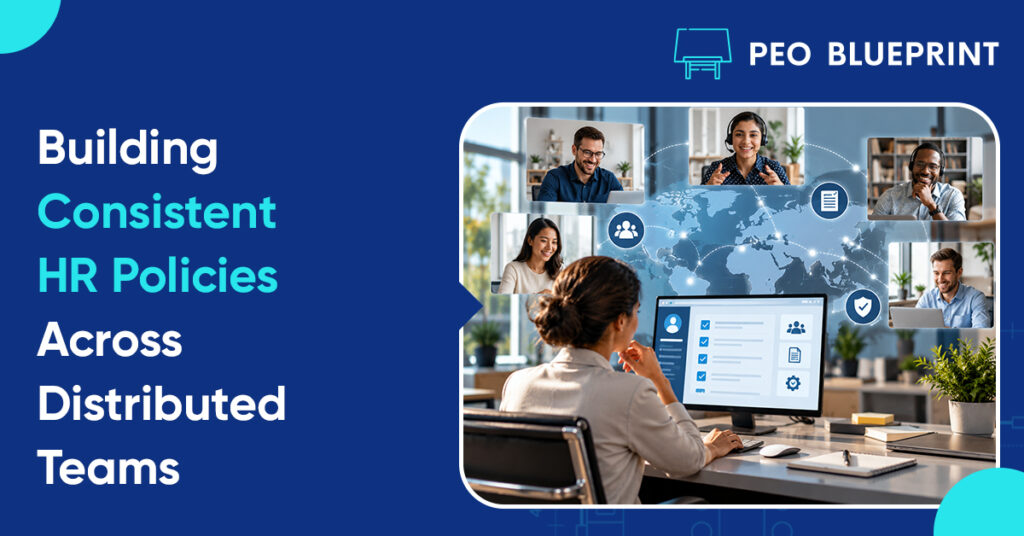
Distributed work has changed how companies hire, manage, and support employees. Teams may now work from different cities, states, time zones, or countries while sharing the same goals, systems, and leadership structure. That flexibility can expand access to talent, but it also creates a major operational challenge: keeping HR Policies consistent without ignoring local requirements.
Strong HR Policies give employees a dependable framework for pay, leave, conduct, performance, communication, benefits, and workplace expectations. In a distributed organization, however, consistency does not mean every employee follows the same rule in every situation. Effective policy design creates a common company standard while allowing lawful adjustments based on location, role, and business needs.
Why Consistency Matters for Distributed Teams
Distributed teams operate across a wider range of circumstances than traditional office-based teams. Employees may have different work schedules, local leave requirements, payroll rules, tax obligations, and communication expectations. Without clear standards, managers can unintentionally create different employee experiences.
Consistent HR Policies establish a baseline for how the organization handles common employment situations. They help employees understand what the company expects and help managers respond to similar situations using the same framework. This reduces dependence on memory, personal judgment, and informal workplace traditions.
Consistency also strengthens organizational trust. Employees are more likely to view decisions as fair when policies are documented, accessible, and applied consistently. A distributed workforce cannot rely on hallway conversations or local office norms to communicate important rules.
However, companies should distinguish consistency from uniformity. Federal, state, and local employment requirements can differ, and a policy may need location-specific language. The U.S. Equal Employment Opportunity Commission explains that employment policies cannot discriminate against protected groups and that even neutral practices can create unlawful disparate impacts in certain circumstances.
Common HR Policy Problems in Distributed Organizations
Many businesses start with policies designed for a single office. As the workforce expands, those policies often remain unchanged, even as the operating environment becomes more complex.
Typical warning signs include:
• Employees in different states receive different answers to the same HR question.
• Managers create informal exceptions because the written policy does not fit remote work.
• Employees cannot easily find the latest version of the handbook or policy.
• Payroll, leave, and benefits practices differ across locations without clear documentation.
• Remote employees are unsure about work hours, availability, equipment, expenses, or communication expectations.
What Consistent HR Policies Should Cover
A strong policy framework should address the employee lifecycle from hiring through separation. The exact policy library depends on the organization, but several areas deserve particular attention.
Hiring and Onboarding
Hiring policies should establish consistent standards for recruiting, interviewing, background checks, documentation, classification, and onboarding. Managers should understand which decisions they can make independently and which require HR review.
Remote onboarding also needs clear expectations for equipment, system access, orientation, training, communication channels, and first-week responsibilities. A structured process helps employees in different locations receive comparable support.
Compensation and Payroll
Distributed teams often create additional payroll complexity. Employees may work in states with different wage, tax, pay-frequency, or expense requirements.
The policy framework should define:
• Pay schedules and payroll procedures.
• Overtime and timekeeping expectations.
• Expense reimbursement rules.
• Compensation review processes.
• Bonus and incentive administration.
• Procedures for correcting payroll issues.
Clear documentation helps employees understand how pay decisions work while giving HR and payroll teams a consistent operating model.
Leave and Time Off
Leave policies are especially important because statutory requirements may vary by location. A company can maintain a consistent time-off philosophy while adding location-specific provisions where required.
The policy should clearly explain eligibility, request procedures, approval responsibilities, documentation, carryover rules, and applicable statutory leave. HR should review these provisions regularly because employment requirements can change.
Remote Work and Attendance
Remote work policies should answer practical questions that office policies often leave unaddressed. Employees need to understand expected working hours, availability, meetings, communication, workspace standards, equipment, travel, and security responsibilities.
The policy should also explain whether remote work is fully remote, hybrid, role-dependent, or subject to business approval. Managers should receive guidance so they do not create different remote-work rules for employees in similar roles without a legitimate reason.
The EEOC notes that telework can sometimes serve as a reasonable accommodation and that employers may need to modify workplace policies for qualified employees with disabilities.
That makes flexibility an important part of policy design, not an exception to ignore.
Build a Core-and-Local Policy Structure
One of the most effective approaches is to separate company-wide standards from location-specific requirements. This creates consistency without pretending that employment law is identical everywhere.
The core policy defines the organization’s general porganization’svers areas such as conduct, performance, communication, information security, confidentiality, workplace behavior, and broad benefits principles.
The local addendum addresses requirements tied to a particular state, locality, or country. It can cover statutory leave, wage requirements, notices, reimbursement rules, and other jurisdiction-specific provisions.
This structure has several advantages:
✅ Employees receive one recognizable company framework.
✅ HR can manage local differences without rewriting the entire handbook.
✅ Managers have clearer guidance when employees work in different jurisdictions.
✅ Policy updates become easier to track.
✅ New locations can be added without rebuilding the entire HR system.
For organizations growing across multiple states, this structure can also make HR administration more scalable.
Create a Policy Governance Process
Policies should not become static documents buried in an employee handbook. Distributed organizations need a governance process that defines who owns each policy, who approves changes, and how employees receive updates.
A practical governance model includes:
• Policy owner responsible for accuracy and business relevance.
• HR or compliance reviewer responsible for legal and operational alignment.
• Leadership approver responsible for major organizational decisions.
• HRIS or document administrator responsible for publishing the approved version.
• Managers responsible for communicating changes to their teams.
Each policy should have a review date, version number, effective date, and clear owner. This creates an audit trail and reduces the risk that employees rely on outdated information.
Organizations should also establish a trigger-based review process. A policy review may be needed after entering a new state, changing benefits, adopting a new HR platform, acquiring another company, or receiving new legal guidance.
Standardize Manager Decisions
Even excellent written policies can fail when managers interpret them differently. Distributed teams increase this risk because managers may operate independently and have fewer opportunities to compare decisions.
Manager training should focus on how policies work in real situations. Instead of simply distributing a handbook, organizations can provide decision guides for common scenarios.
For example, a manager may need to know:
• When to involve HR.
• How to document performance concerns.
• How to respond to leave requests.
• When a remote-work request requires HR review.
• How to handle employee complaints.
• Which compensation discussions require approval.
• What information managers should keep confidential.
Standardized decision paths reduce improvisation. They also help HR identify recurring questions that may indicate unclear policy language.
Make Policies Easy to Find
A policy cannot create consistency if employees cannot find it. Distributed teams need a reliable digital source of truth.
An HRIS, employee portal, or controlled document repository can provide centralized access. Each policy should have a clear title, effective date, owner, and version number. Employees should not have to search through old emails to find the current document.
Digital accessibility also supports accountability. When employees can review policies independently, HR teams spend less time answering repetitive questions.
Organizations should also consider how policy acknowledgments work. Important policies may require employees to confirm that they received and reviewed the latest version. Retain records according to the organization’s document retention policies.
Use Technology to Support Policy Consistency
Technology cannot replace good policy design, but it can reduce administrative variation. An HRIS can centralize employee records, workflows, onboarding, time-off requests, and policy acknowledgments.
Automation can also create useful controls. For example, a system can route certain requests to HR based on employee location or employment type. It can provide different forms or notices where local requirements apply.
The key is to automate repeatable processes while preserving human review for sensitive decisions. A fully automated workflow may create problems if the underlying rules are incomplete or incorrectly configured.
Technology should support a documented policy framework rather than replace it.
Train Employees, Not Just Managers
Employees need more than access to a handbook. They need to understand the policies that affect their daily work.
Training should focus on practical expectations such as conduct, harassment prevention, data protection, timekeeping, leave requests, workplace safety, and remote-work responsibilities. New employees should receive this information during onboarding, while existing employees should receive updates when material changes occur.
Training should also account for distributed communication. A live meeting may not reach every employee at a convenient time. Recorded sessions, written summaries, FAQs, and digital acknowledgments can create a more consistent experience.
The objective is not to overwhelm employees with legal language. It is to translate policy into clear actions and decisions.
Account for Local Employment Requirements
A national policy cannot assume every employment rule applies the same way across all jurisdictions. Businesses should identify the locations where employees work and maintain a current compliance matrix.
The matrix can track:
• Employee location.
• Work classification.
• Applicable leave requirements.
• Wage and hour considerations.
• Required notices.
• Reimbursement rules.
• Benefits requirements.
• Payroll and tax considerations.
• Local policy variations.
This does not mean every business needs a separate handbook for every state. A centralized core with carefully maintained local supplements can provide a more manageable approach.
Businesses should obtain qualified legal or compliance advice when requirements are complex or uncertain. Government agencies remain important sources of authoritative information, including the EEOC’s guidance on employment discrimination and reasonable accommodation.
Protect Fairness Across Locations
Consistency should never become a reason to ignore legitimate employee differences. Distributed employees may have different legal rights or reasonable workplace needs depending on their circumstances.
The EEOC states that employers may need to provide reasonable accommodations for qualified employees with disabilities and that workplace policies may need modification in appropriate circumstances.
A sound policy framework therefore includes a process for exceptions and accommodations. The goal is not to make every outcome identical. The goal is to make decisions consistent with policy, documented, explainable, and legally compliant.
Managers should avoid creating informal exceptions that are never documented. If an exception is necessary, HR should determine whether the situation requires a formal policy clarification, an accommodation process, or a one-time business decision.
Audit HR Policies Regularly
Policy consistency requires ongoing review. Companies should audit their HR Policies at least annually and more frequently when the workforce or regulatory environment changes.
An audit can examine whether:
• Policies match current business practices.
• Local addenda remain accurate.
• Managers apply policies consistently.
• Employees can access current documents.
• Acknowledgments are properly recorded.
• Payroll and leave practices match written policies.
• Remote-work arrangements are documented.
• New jurisdictions have been incorporated.
• Policy changes have been communicated.
Internal audits can reveal gaps before they become employee disputes or compliance issues. They also create a stronger record of proactive HR management.
Build a Practical Implementation Process
Creating consistent HR Policies does not require rebuilding the entire HR function at once. A phased implementation can reduce disruption and help leadership prioritize the highest-risk areas.
Inventory existing policies. Collect handbooks, manager guides, offer templates, leave documents, remote-work agreements, and location-specific policies.
Map employee locations. Identify every state or jurisdiction where employees work and determine which policies require local treatment.
Identify inconsistencies. Compare written policies with actual manager practices, payroll processes, and employee experiences.
Define the core framework. Establish company-wide standards that should apply across the workforce.
Create local supplements. Add legally required or operationally necessary location-specific provisions.
Assign policy ownership. Give each major policy an accountable owner and review schedule.
Update technology workflows. Configure HRIS, payroll, onboarding, and acknowledgment processes to support the approved policies.
Train managers and employees. Explain the changes using practical examples and clear communication.
Monitor adoption. Track questions, exceptions, complaints, and recurring process failures.
Review and improve. Use audit findings and employee feedback to refine the policy framework.
Clear policies also help leaders compare workforce practices across locations without losing sight of local realities. This creates visibility for planning, budgeting, hiring, and future expansion.
How a PEO Can Support Distributed HR Operations
Managing distributed HR Policies internally can become difficult as a company grows. Leadership may have limited HR capacity while facing increasing complexity around payroll, benefits, compliance, employee administration, and multi-state employment.
A professional employer organization can provide the administrative infrastructure and HR support businesses need to manage these responsibilities. The right PEO can support payroll administration, benefits, HR technology, compliance processes, and employee management while giving leadership access to broader HR expertise.
PEO Blueprint helps businesses with 1 to 500 employees evaluate PEO options and build HR strategies around their specific needs.
Its approach includes evaluating HR and compliance exposure, benefits costs, administrative workflows, technology gaps, and workforce requirements before recommending a PEO. That assessment-based approach can be particularly useful for businesses managing distributed or multi-state teams.
Businesses can also explore PEO resources to understand how organizations have addressed multi-state compliance, remote workforce challenges, benefits administration, and HR infrastructure.
Benefits of a Consistent Policy Framework
A well-designed policy system can create operational advantages across the organization.
✅ Greater employee clarity: Employees understand expectations and know where to find answers.
✅ More consistent management: Managers have a shared framework for handling common situations.
✅ Reduced compliance exposure: HR can identify jurisdiction-specific requirements before problems arise.
✅ Scalable growth: New employees and locations can be added without reinventing core processes.
✅ Better employee experience: Consistent onboarding, leave, communication, and support create greater predictability.
✅ Stronger documentation: Version control and policy acknowledgments create a clearer administrative record.
✅ More efficient HR operations: Standard workflows reduce repetitive questions and manual intervention.
Mistakes to Avoid
Some policy strategies create more complexity instead of reducing it. Distributed organizations should watch for several common mistakes.
Treating Every Employee Identically
Equal treatment does not always mean identical treatment. Local law, job requirements, accommodations, and legitimate business conditions can require different procedures.
Letting Managers Write Their Own Rules
Managers need reasonable discretion, but they should not create unofficial employment policies. Informal rules can produce inconsistency and increase compliance risk.
Updating Policies Without Updating Systems
A new written policy has limited value if payroll, HRIS workflows, forms, or manager instructions still follow the old process.
Using Legal Language Employees Cannot Understand
Policies should be accurate but readable. Employees should understand what they need to do without interpreting dense legal terminology.
Ignoring Policy Communication
Publishing a revised handbook without explaining the changes can create confusion. Significant updates should include clear communication and, when appropriate, training or acknowledgment.
Failing to Document Exceptions
One-off arrangements can become precedent if managers repeat them without understanding the reason. HR should document significant exceptions and assess whether a broader policy change is necessary.
A Sustainable Model for Distributed HR
For distributed teams, the most practical model combines three elements: a consistent company core, local compliance flexibility, and disciplined governance. The company core creates a shared employee experience. Local supplements address jurisdictional differences. Governance ensures policies remain accurate as the organization changes.
Leadership should also view policy management as part of business infrastructure. When hiring accelerates, a reliable policy framework helps the organization absorb growth without forcing every HR decision back to the founders or executive team.
That becomes especially important for small and midsize companies. They often need sophisticated HR processes before they have the resources to build large internal HR departments. Strategic HR support, technology, and the right PEO relationship can help close that gap.
Questions to Ask Before Expanding a Distributed Team
Before hiring employees in a new location, leadership should ask:
• Do we know which employment requirements apply in this jurisdiction?
• Are our compensation and payroll processes prepared for the new location?
• Does our handbook explain remote-work expectations clearly?
• Can employees access the latest policies digitally?
• Are managers trained to apply policies consistently?
• Do our HRIS and payroll workflows support location-specific requirements?
• Do we have a process for accommodations and exceptions?
• Who owns the policy review process?
• When did we last audit our HR Policies?
Conclusion
Building consistent HR Policies across distributed teams requires more than copying an office handbook into a digital file. Businesses need a structured framework that combines company-wide standards with appropriate local requirements, clear governance, manager training, accessible documentation, and reliable HR technology.
The objective is consistency with flexibility. Employees should understand the organization’s core expeorganization’se HR experience, and managers should have a defined process for handling legitimate differences based on location, role, or individual circumstances.
As distributed teams expand, policy management becomes an important part of scalable workforce strategy. Regular audits, documented ownership, local compliance reviews, and standardized workflows can help businesses reduce confusion and improve the employee experience.
For companies that want additional support, a PEO can provide HR infrastructure, benefits administration, payroll support, compliance resources, and technology that make distributed workforce management more manageable. Explore PEO Blueprint
Consistent HR Policies do not eliminate every difference across a distributed workforce. Instead, they create a dependable system for managing those differences responsibly. With the right framework, businesses can give employees clarity, equip managers to make better decisions, and build an HR operation that can scale with the company.