Search fund acquisitions give entrepreneurs a direct path to business ownership without starting a company from scratch. Instead of building a business from zero, a searcher identifies an established company, completes due diligence, secures financing, and takes over operations. Yet the transition from searcher to owner creates a major operational challenge: managing people.
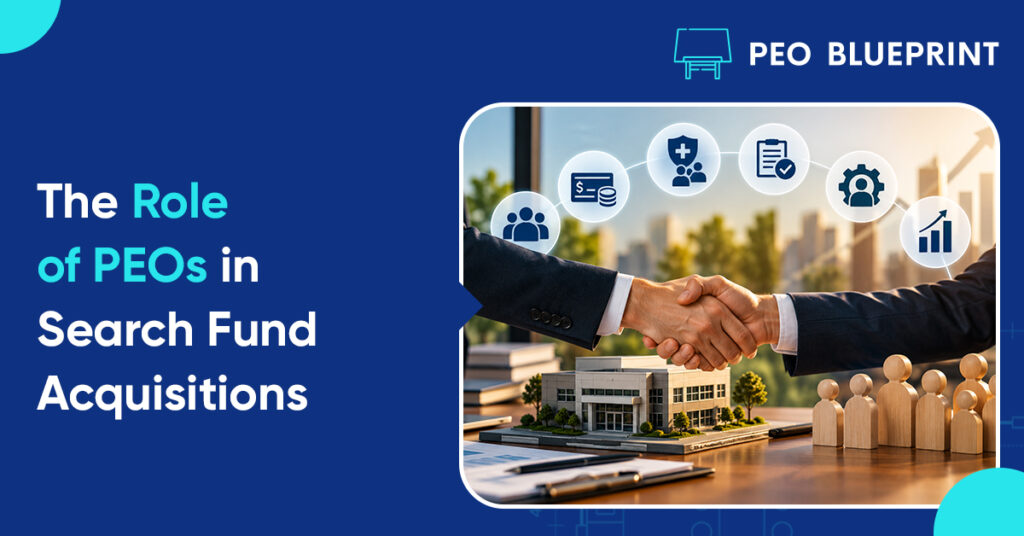
That is where PEOs in Search Fund Acquisitions can provide meaningful value. A Professional Employer Organization can support payroll, employee benefits, human resources, compliance, workers’ compensation, and other workforce functions while the new owner focuses on customers, revenue, operations, and growth.
According to Stanford Graduate School of Business, search funds enable entrepreneurs to locate, acquire, manage, and grow privately held companies. Its 2026 Search Fund Study continues to track the model and its performance across decades of acquisitions.
For a first-time CEO, outsourcing complex employment administration can make the post-acquisition transition more manageable. A PEO does not replace executive leadership, but it can provide an infrastructure that supports the workforce while the owner concentrates on creating enterprise value.
What Is a PEO?
A Professional Employer Organization is a company that provides outsourced employment-related services to businesses through a contractual relationship. Depending on the arrangement, a PEO may handle payroll administration, employment tax responsibilities, benefits administration, human resources, workers’ compensation, unemployment claims, and other workforce services.
The Internal Revenue Service explains that PEOs can perform some or all federal employment tax withholding, reporting, and payment functions associated with workers performing services for a client.
A PEO relationship is often described as a co-employment arrangement. The client business continues to control its day-to-day operations, employees, customers, strategy, and business decisions, while the PEO manages agreed employment-related functions.
This distinction matters after an acquisition. The searcher becomes responsible for running the acquired business, but that does not mean the new owner must personally build an entire HR department.
A PEO can provide access to specialized professionals and established processes without requiring the acquired company to hire a large internal HR team immediately.
For searchers evaluating workforce infrastructure, PEO Blueprint provides resources focused on understanding PEO services, workforce administration, and employer solutions.
Why Search Fund Acquisitions Create HR Challenges
A search fund acquisition often involves a transition period where the new owner must learn the business while maintaining employee confidence. Employees may wonder whether compensation, benefits, leadership, job responsibilities, or workplace policies will change.
At the same time, the buyer may discover that the company has limited HR infrastructure. Some small businesses rely on an office manager, bookkeeper, payroll provider, or outside accountant to handle employment administration.
That approach may work when the company has a stable ownership structure. It can become less effective when a new owner introduces growth initiatives, changes processes, expands the workforce, or enters new markets.
The acquisition also creates an opportunity to identify employment risks that were previously overlooked.
• Inconsistent employee records
• Outdated handbooks and policies
• Payroll process weaknesses
• Benefits administration gaps
• Workers’ compensation exposure
• Misclassification concerns
• Inconsistent onboarding procedures
• Poor documentation practices
• State-specific employment compliance issues
These issues may not prevent an acquisition, but they can consume valuable management time after closing.
That is one reason PEOs in Search Fund Acquisitions deserve consideration before the transaction closes, not only after problems appear.
The Role of PEOs in Search Fund Acquisitions
A PEO can serve as an operational support layer between the new owner and many routine workforce responsibilities. Its role becomes particularly useful when the acquired company has a small administrative team or when the searcher has limited experience managing employment infrastructure.
The PEO does not acquire the company, manage the business strategy, or make executive decisions. Instead, it supports the employer through specialized services.
The relationship can cover several areas.
Payroll Administration
Payroll accuracy becomes critical immediately after closing. Employees expect wages to arrive correctly and on time, regardless of an ownership transition.
A PEO can manage payroll processing, payroll tax administration, employee deductions, reporting, and related workflows. This creates a standardized process that can reduce administrative pressure on the new owner.
The IRS notes that employment tax responsibilities can depend on the structure of the PEO relationship and the degree of control the PEO exercises over wage payments.
For a searcher, this means reviewing the PEO agreement carefully with qualified advisors so responsibilities are clearly understood.
Employee Benefits
Benefits can become a sensitive issue during an acquisition. Employees may fear losing health insurance, retirement benefits, paid time off, or other programs.
A PEO can potentially provide access to broader benefits infrastructure and handle much of the associated administration. Depending on the provider and plan structure, this may make benefits easier for a smaller company to manage.
The value is not simply administrative. A competitive benefits package can help the new owner retain employees during uncertainty.
Human Resources Support
Searchers often have strong financial, operational, or entrepreneurial skills but limited HR experience. A PEO can provide access to HR professionals who understand employee relations, onboarding, policies, documentation, and workplace practices.
This is especially valuable when the acquired company has no dedicated HR leader.
The owner still makes business decisions. However, the PEO can provide guidance and administrative support around the workforce processes that support those decisions.
Employment Compliance
Employment laws can vary by federal, state, and local jurisdiction. A company operating across multiple states can therefore face a more complicated compliance environment.
PEOs can help clients manage employment-related processes, maintain documentation, administer policies, and stay organized around regulatory obligations.
The IRS also notes that many states have laws governing PEO licensing and reporting, reinforcing the importance of selecting a provider that understands the applicable jurisdictions.
Workers’ Compensation
Workers’ compensation administration can create another layer of complexity after an acquisition. A PEO may coordinate workers’ compensation programs, claims administration, audits, and related processes.
This can reduce the number of workforce vendors the new owner must manage.
Unemployment Administration
Unemployment claims and state requirements can become time-consuming when a company lacks dedicated HR resources. A PEO can help administer unemployment-related processes and maintain appropriate records.
This support lets the owner focus on strategic priorities.
Why PEO Support Matters During the Transition
The first 100 days after an acquisition can shape the company’s long-term trajectory. The new owner must establish credibility, understand operations, communicate with employees, and identify growth opportunities.
Administrative distractions can interfere with that work.
A PEO can help create continuity in workforce administration while ownership changes.
Consider a searcher who acquires a 60-employee manufacturing company. The previous owner personally approved payroll, handled benefit questions, resolved employee issues, and worked with an external accountant.
After closing, the new owner wants to improve production, strengthen sales, modernize reporting, and meet key customers.
Without additional support, those HR responsibilities may suddenly become the CEO’s problem.
With an appropriate PEO arrangement, many administrative functions can move into a defined operating process.
That does not eliminate responsibility. It creates leadership capacity.
PEOs Can Help Protect Management Time
Time is one of the most valuable resources for a newly acquired company.
Searchers frequently enter businesses with a clear improvement thesis. They may see opportunities to increase pricing, improve customer retention, modernize technology, expand sales, improve operational efficiency, or develop new services.
None of those initiatives require the CEO to process payroll manually.
A PEO can absorb recurring administrative workloads so the owner can focus on activities that directly influence enterprise value.
The benefits can include:
✅ More management attention available for revenue growth
✅ More consistent payroll and HR processes
✅ Better access to HR expertise
✅ Greater structure around employee documentation
✅ More organized benefits administration
✅ Reduced administrative fragmentation
The objective is not to outsource leadership. It is to outsource repeatable employment administration where specialized support can improve efficiency.
PEOs and Acquisition Due Diligence
A PEO should not be treated as an afterthought. Searchers should consider workforce infrastructure during due diligence.
Before selecting a provider, buyers should understand the existing employment environment.
Important questions include:
• How many employees does the company have?
• Which states employ those workers?
• What payroll system is currently being used?
• What benefits are offered?
• How are workers’ compensation claims handled?
• Are employment agreements documented?
• Is there an employee handbook?
• Are payroll taxes current?
• Are there pending employment disputes?
• How are independent contractors classified?
• What HR responsibilities currently sit with the owner?
These questions can reveal operational gaps before they become post-closing problems.
A PEO may then become part of the integration plan rather than an emergency response.
Evaluating the Existing Workforce Before Closing
People-related due diligence deserves the same discipline as financial and operational diligence.
The buyer should understand compensation structures, employee tenure, key-person dependencies, benefits, turnover, open positions, and employment liabilities.
A strong workforce review can identify both risks and opportunities.
For example, an acquisition target may have a loyal workforce but weak benefits administration. Another company may have strong benefits but poor employee documentation.
A PEO can potentially address administrative weaknesses, but it cannot fix every underlying workforce problem.
If a company has serious employee relations issues, unresolved litigation, or poor leadership practices, the buyer needs legal and HR professionals to evaluate those matters independently.
The PEO should be viewed as part of the solution, not the entire solution.
Selecting the Right PEO After an Acquisition
Not every PEO is appropriate for every search fund acquisition. Provider selection should reflect the acquired company’s size, workforce profile, locations, industry, growth plans, and administrative requirements.
Searchers should compare providers carefully before signing a long-term agreement.
Key criteria include:
- Service scope: Determine which payroll, HR, benefits, compliance, workers’ compensation, and technology services are included.
- Industry experience: Look for experience with businesses that have similar workforce and regulatory requirements.
- Geographic coverage: Confirm the provider can support every state where employees work.
- Technology: Evaluate payroll, HR, benefits, employee self-service, reporting, and integration capabilities.
- Implementation support: Understand how the transition will be managed after closing.
- Pricing: Review administrative fees, per-employee charges, benefit costs, and other potential expenses.
- Contract terms: Examine renewal provisions, termination requirements, service commitments, and implementation charges.
- Compliance resources: Determine what compliance support the provider actually delivers and what remains the client’s responsibility.
- Client support: Assess response times, account management, and access to HR specialists.
- Financial and regulatory standing: Verify relevant certifications, registrations, and provider credentials.
Select a provider based on operational fit, not just price.
Should Searchers Choose a CPEO?
Some searchers may consider an IRS-certified Professional Employer Organization, or CPEO.
The IRS operates a voluntary certification program for PEOs. Certified organizations must meet requirements involving areas such as financial responsibility, tax compliance, organizational integrity, and other program standards.
The IRS publishes a list of certified PEOs, including certification effective dates and information about suspended or revoked certifications.
Certification does not automatically make one PEO better than another for every acquisition. However, it provides an important verification point when evaluating providers.
Searchers should review the provider’s current status and discuss the implications of the PEO structure with their tax and legal advisors.
PEO Costs Versus Internal HR Costs
The cost question should extend beyond the PEO’s stated fee.
A newly acquired company could theoretically hire an HR manager, payroll specialist, benefits administrator, compliance professional, and additional support staff.
That internal structure may make sense at a certain scale. For a smaller acquisition, however, building the entire infrastructure internally may not be efficient.
The relevant comparison is therefore not simply:
PEO fee versus payroll software fee.
The more useful comparison is:
PEO cost versus total internal workforce administration cost, risk, technology, benefits administration, professional expertise, and management time.
A PEO may offer economies of scale that would be difficult for a small company to reproduce independently.
Still, searchers should model the economics carefully. PEO pricing varies based on workforce size, services, benefits, workers’ compensation, risk profile, geography, and other factors.
How PEOs Can Support Growth After Acquisition
Search fund acquisitions often focus on creating value through operational improvement and growth. Workforce infrastructure must keep pace with those ambitions.
Suppose a newly acquired company plans to increase its employee count by 30% over two years.
The owner will need a scalable approach to recruiting, onboarding, payroll, benefits, compliance, employee records, and HR support.
A PEO can provide that foundation.
The same principle applies when the company enters a new state.
Rather than creating an entirely new administrative process, the owner may be able to use the PEO’s existing infrastructure and expertise.
That can make expansion more predictable.
PEOs and Employee Retention
Employee retention becomes especially important after an ownership transition.
Employees may worry about layoffs, benefit changes, cultural changes, or new management expectations. Poor communication can increase uncertainty and accelerate turnover.
A PEO cannot solve cultural problems, but it can support a more organized employee experience.
Consistent onboarding, accessible benefits information, accurate payroll, clear HR policies, and responsive employee support can strengthen workforce confidence.
The new owner should pair those administrative capabilities with direct communication.
Employees need to understand the company’s direction, what will change, what will remain stable, and how leadership plans to support them.
Common Mistakes Searchers Should Avoid
PEOs can create significant value, but only when the relationship is structured correctly.
Several mistakes can reduce that value.
• Choosing a provider solely because it has the lowest price
• Assuming the PEO takes responsibility for every employment issue
• Failing to review the service agreement
• Ignoring state-specific requirements
• Switching systems without a detailed implementation plan
• Failing to communicate benefits changes to employees
• Treating HR outsourcing as a substitute for leadership
• Selecting a provider without checking references
• Overlooking data migration and payroll accuracy during implementation
• Failing to coordinate the PEO with legal, tax, accounting, and insurance advisors
The most successful implementation treats the PEO as part of an integrated operating model.
A Practical PEO Integration Plan
Searchers can make the transition smoother by organizing implementation before the acquisition closes.
- Map current processes. Document payroll, benefits, HR, workers’ compensation, onboarding, and compliance workflows.
- Identify gaps. Separate critical risks from routine administrative inefficiencies.
- Define responsibilities. Determine exactly what the PEO will manage and what remains with the company.
- Select the provider. Compare service scope, technology, pricing, support, and experience.
- Prepare employee data. Validate employee records, compensation, deductions, benefits, tax information, and required documentation.
- Communicate the transition. Explain what employees should expect and where they can obtain assistance.
- Test payroll. Conduct appropriate validation before the first live payroll under the new arrangement.
- Monitor the first 90 days. Review payroll accuracy, employee questions, benefits administration, compliance tasks, and service responsiveness.
This approach reduces avoidable disruption and gives the new owner a clearer operating baseline.
How PEOs Fit Into the Broader Acquisition Team
A searcher rarely completes an acquisition alone. The broader team may include attorneys, accountants, lenders, investors, insurance advisors, consultants, and operating partners.
The PEO should complement that team.
The attorney handles legal matters. The accountant evaluates financial information. The tax advisor addresses tax implications. The insurance professional evaluates coverage. The PEO supports workforce administration.
Clear boundaries matter.
A PEO should not be expected to provide legal opinions or replace specialized transaction counsel. Instead, it should coordinate with the appropriate professionals when employment issues affect the transaction or post-closing operations.
This integrated approach creates stronger governance.
PEOs Can Support the Searcher’s Operating Model
The value of PEOs in Search Fund Acquisitions extends beyond payroll.
A PEO can become part of the searcher’s operating system for people management.
That can include standardized onboarding, employee records, benefits administration, payroll reporting, HR support, workers’ compensation coordination, and recurring compliance processes.
For a first-time owner, that structure can create confidence.
Instead of inventing every HR process after closing, the searcher can adopt a more established framework and customize it to the business.
This is especially useful when the acquired company has historically depended on informal processes.
When a PEO May Not Be the Best Choice
A PEO is not automatically the right answer for every acquisition.
Larger companies with mature HR departments may already have sophisticated systems, internal specialists, and established benefit programs.
A business may also have unusual workforce requirements that make a particular PEO structure less suitable.
Some companies may prefer an administrative services organization or other outsourced HR model instead.
The decision should therefore follow the company’s needs rather than a generic assumption that every acquisition should use a PEO.
Searchers should compare alternatives based on cost, control, complexity, compliance needs, employee experience, and growth plans.
The Strategic Advantage of Getting HR Right
Search fund investors expect the new CEO to create value after acquisition. That requires attention to customers, employees, cash flow, operations, strategy, and growth.
Workforce administration may not be the most visible part of that mission, but it can influence almost every part of the company.
Payroll problems damage trust. Benefits problems affect retention. Compliance problems create risk. Poor onboarding slows productivity. Weak HR processes consume management time.
A well-designed PEO relationship can reduce those friction points.
That does not guarantee acquisition success. It simply creates stronger operational infrastructure for the people side of the business.
Final Thoughts on PEOs in Search Fund Acquisitions
PEOs in Search Fund Acquisitions can provide valuable workforce infrastructure for entrepreneurs taking control of an established company. By supporting payroll, benefits, HR administration, workers’ compensation, unemployment processes, and employment compliance, a PEO can reduce administrative complexity during an important ownership transition.
The opportunity is especially compelling for first-time CEOs who need to focus their attention on customers, employees, operational improvement, and growth rather than building every HR process internally.
However, the right PEO relationship requires careful evaluation. Searchers should complete workforce due diligence, understand employment responsibilities, compare providers, review contract terms, evaluate costs, and coordinate the PEO with legal, tax, accounting, and insurance professionals.
Stanford’s current research shows that search funds remain an established path to entrepreneurship through acquisition, with entrepreneurs continuing to locate, acquire, and operate privately held companies. As this model evolves, operational discipline will remain essential.
A PEO cannot make an acquisition successful on its own. It can provide scalable people infrastructure that lets the new owner spend more time creating value.
For searchers evaluating their post-acquisition workforce strategy, PEO resources and guidance can provide a starting point for understanding how outsourced HR and employment services may fit into the broader operating model.
The strongest acquisition strategy does not stop at closing the deal. It builds the systems, people, processes, and infrastructure required to turn the acquired company into a stronger business. For many searchers, a carefully selected PEO can become an important part of that foundation.