Human Resources has evolved significantly over the past two decades. What was once perceived as a transactional, back-office function is now expected to operate as a strategic growth engine. Organizations navigating competitive markets, regulatory complexity, and workforce shifts must transition from administrative HR to strategic HR with clarity and precision.
This is where PEO Alignment becomes transformative.
Rather than outsourcing HR solely for cost savings, forward-thinking companies leverage PEO Alignment to reposition HR as a strategic business partner. By aligning operational processes, compliance frameworks, talent management strategies, and workforce analytics, organizations unlock measurable value and scalable growth.
This article explores how PEO Alignment accelerates HR transformation, enhances leadership effectiveness, and builds sustainable competitive advantage.
Understanding the Shift: Administrative HR vs. Strategic HR
Before exploring transformation, it is essential to distinguish between administrative HR and strategic HR.
Administrative HR: The Traditional Model
Administrative HR focuses primarily on transactional tasks:
✔ Payroll processing
✔ Benefits administration
✔ Compliance documentation
✔ Employee records management
✔ Policy enforcement
While these functions are critical, they are reactive and operational. They ensure stability but rarely drive growth.
Organizations operating solely within this framework often experience:
- Limited workforce analytics
- Reactive compliance management
- Minimal executive-level HR influence
- Inefficient technology systems
- Talent strategies disconnected from business objectives
Administrative HR protects the business. It does not actively propel it forward.
Strategic HR: The Modern Imperative
Strategic HR integrates people strategy with business strategy. It contributes directly to revenue growth, innovation, and organizational agility.
Strategic HR focuses on:
✔ Workforce planning aligned with growth targets
✔ Leadership development pipelines
✔ Data-driven talent decisions
✔ Cultural architecture
✔ Risk mitigation at the executive level
✔ Organizational design optimization
In this model, HR becomes a consultative function, influencing boardroom decisions and shaping long-term success.
The challenge lies in the transition. Many companies aspire to move toward strategic HR but remain trapped in administrative complexity. This is precisely where PEO Alignment becomes essential.
What Is PEO Alignment?
PEO Alignment refers to the structured integration of a Professional Employer Organization (PEO) partnership with a company’s long-term business strategy. It is not merely outsourcing payroll or benefits—it is synchronizing HR operations with organizational goals through a co-employment model.
A Professional Employer Organization provides:
- Payroll and tax administration
- Benefits management
- Regulatory compliance support
- Risk management
- HR technology infrastructure
However, when implemented strategically, PEO Alignment does much more. It redistributes operational burdens, enabling internal HR teams to focus on strategic initiatives.
Without alignment, a PEO relationship remains transactional. With alignment, it becomes transformational.
Why Organizations Struggle to Transition
Many companies recognize the need for strategic HR but encounter structural obstacles:
Operational Overload
HR teams spend 60–80% of their Time on administrative tasks. This leaves little capacity for:
- Workforce analytics
- Talent strategy
- Leadership coaching
- Culture development
Compliance Complexity
Regulatory frameworks evolve constantly at the federal, state, and local levels. Compliance consumes Time and introduces risk.
Fragmented Technology Systems
Disconnected payroll, benefits, time-tracking, and performance platforms create inefficiencies and data silos.
Leadership Misalignment
Without clear alignment between HR and executive leadership, transformation stalls.
PEO Alignment addresses each of these constraints simultaneously.
How PEO Alignment Accelerates HR Transformation
- Liberating HR Capacity for Strategic Focus
By transferring administrative processes to a PEO partner, organizations reclaim internal HR bandwidth.
This allows HR leaders to concentrate on:
✔ Succession planning
✔ Organizational design
✔ Talent acquisition strategy
✔ Performance management innovation
✔ Employee engagement architecture
Example:
A 200-employee technology firm partnered with a PEO to manage payroll, benefits, and compliance. Within six months, internal HR leaders shifted Focus toward leadership development and reduced turnover by 18%.
PEO Alignment enables this shift by removing operational noise.
- Elevating Compliance from Reactive to Proactive
Compliance risk can derail growth. Employment laws, wage regulations, and benefits requirements vary widely.
Through PEO Alignment:
✔ Regulatory monitoring becomes continuous
✔ Risk exposure decreases
✔ Audit readiness improves
✔ Employment practices are standardized
This proactive compliance posture allows executives to expand into new markets with confidence.
- Enhancing Access to Competitive Benefits
Talent acquisition is increasingly competitive. Small and mid-sized businesses often struggle to offer enterprise-level benefits.
PEO Alignment provides:
✔ Access to large-group health plans
✔ Enhanced retirement options
✔ Employee assistance programs
✔ Voluntary benefits expansion
Improved benefits packages directly impact:
- Recruitment competitiveness
- Retention rates
- Employer brand perception
In strategic HR, benefits are not merely expenses—they are talent investment tools.
- Leveraging Integrated HR Technology
Technology fragmentation limits insight. PEO platforms often consolidate:
✔ Payroll systems
✔ Benefits administration
✔ Time tracking
✔ Performance management
✔ Analytics dashboards
With unified systems, organizations gain:
- Real-time workforce insights
- Accurate labor cost forecasting
- Data-driven decision-making
Strategic HR relies on data. PEO Alignment provides infrastructure to support it.
- Strengthening Workforce Planning
Strategic workforce planning requires:
- Headcount forecasting
- Skills gap analysis
- Succession mapping
- Productivity metrics
Through PEO Alignment, companies gain analytical support and structured reporting frameworks. HR leaders can model workforce scenarios aligned with revenue goals.
For example, expanding into new regions becomes more predictable when compliance, benefits, and payroll logistics are already optimized.
The Financial Impact of PEO Alignment
Transformation must demonstrate return on investment.
Organizations leveraging PEO Alignment often experience:
✔ Reduced administrative overhead
✔ Lower compliance penalties
✔ Improved employee retention
✔ Decreased workers’ compensation costs
✔ Greater operational scalability
Beyond cost savings, the strategic value lies in risk reduction and growth enablement.
Consider the alternative: compliance errors, payroll inaccuracies, and mismanaged benefits can result in financial and reputational damage.
PEO Alignment mitigates these risks while enabling HR innovation.
Cultural Transformation Through Strategic HR
Strategic HR shapes organizational culture.
When HR leaders are freed from administrative burdens, they can focus on:
✔ Leadership coaching
✔ Diversity, equity, and inclusion strategies
✔ Employee experience design
✔ Performance-driven cultures
PEO Alignment indirectly influences culture by reallocating attention toward human capital development.
Culture is not accidental—it is architected. Strategic HR architects it deliberately.
Executive-Level Partnership and Governance
HR transformation requires executive sponsorship.
Through PEO Alignment:
- Reporting structures become clearer
- Risk oversight strengthens
- Board-level compliance transparency improves
- Strategic initiatives gain operational support
When HR has credible data and reliable systems, leadership trust increases.
This elevates HR from a support function to a strategic advisor.
Implementation Framework for Effective PEO Alignment
Successful transformation requires structured execution.
Step 1: Conduct an HR Audit
Evaluate:
✔ Administrative workload distribution
✔ Compliance vulnerabilities
✔ Technology gaps
✔ Talent management maturity
Step 2: Define Strategic Objectives
Align HR goals with:
- Revenue growth
- Market expansion
- Workforce scalability
- Innovation initiatives
Step 3: Select the Right PEO Partner
Assess:
✔ Industry expertise
✔ Technology capabilities
✔ Compliance track record
✔ Service model alignment
Step 4: Establish Governance and Communication Protocols
Clear accountability prevents confusion in co-employment arrangements.
Step 5: Measure Outcomes
Track:
✔ Time reallocated to strategic initiatives
✔ Turnover reduction
✔ Compliance incident rates
✔ Employee satisfaction metrics
Transformation must be measurable.
Common Misconceptions About PEO Alignment
“It Eliminates Internal HR”
Incorrect. PEO Alignment strengthens internal HR by removing operational friction.
“It’s Only for Small Businesses”
Mid-sized and high-growth companies benefit significantly, particularly during scaling phases.
“It’s Just Outsourcing”
Outsourcing is transactional. Alignment is strategic.
Long-Term Strategic Advantages
Over Time, organizations leveraging PEO Alignment develop:
✔ Stronger talent pipelines
✔ Enhanced employer branding
✔ Greater agility during economic shifts
✔ Improved regulatory resilience
✔ Scalable infrastructure for growth
Strategic HR becomes embedded in the organization’s DNA.
Case Scenario: Scaling with Strategic Confidence
Imagine a 150-employee manufacturing company planning national expansion.
Without alignment:
- HR team overwhelmed
- Compliance complexity increases
- Benefits competitiveness declines
- Leadership distracted
With PEO Alignment:
✔ Multi-state compliance managed
✔ Scalable payroll systems implemented
✔ Benefits upgraded
✔ HR leadership focused on workforce planning
Expansion becomes structured rather than chaotic.
The Future of HR Leadership
The future belongs to organizations that treat human capital as strategic capital.
Emerging trends demand adaptability:
- Remote workforce management
- AI-enabled HR analytics
- Skills-based hiring models
- Workforce mobility
Administrative HR cannot manage this complexity alone.
PEO Alignment creates a stable foundation for innovation to thrive.
Governance Architecture in a Co-Employment Environment
As organizations mature in their transformation journey, governance becomes increasingly critical. Strategic growth without structured oversight exposes the organization. One overlooked advantage of PEO Alignment is the clarity it brings to governance architecture.
When roles, responsibilities, and escalation protocols are clearly defined between the employer and the PEO partner, organizations benefit from:
✔ Clear delineation of employer-of-record responsibilities
✔ Standardized policy frameworks
✔ Coordinated legal response mechanisms
✔ Structured risk-sharing models
Rather than navigating employment complexities independently, leadership teams gain a framework that enhances accountability and transparency.
This governance maturity elevates HR discussions to executive-level strategy rather than operational troubleshooting.
Transforming HR Analytics into Executive Intelligence
Data alone does not drive transformation. Interpretation and alignment do.
A critical benefit of PEO Alignment lies in converting fragmented HR metrics into actionable executive intelligence. When payroll, benefits, Performance, and workforce data operate within unified ecosystems, leadership gains predictive capability rather than reactive reporting.
With aligned systems, organizations can:
✔ Forecast labor costs against revenue projections
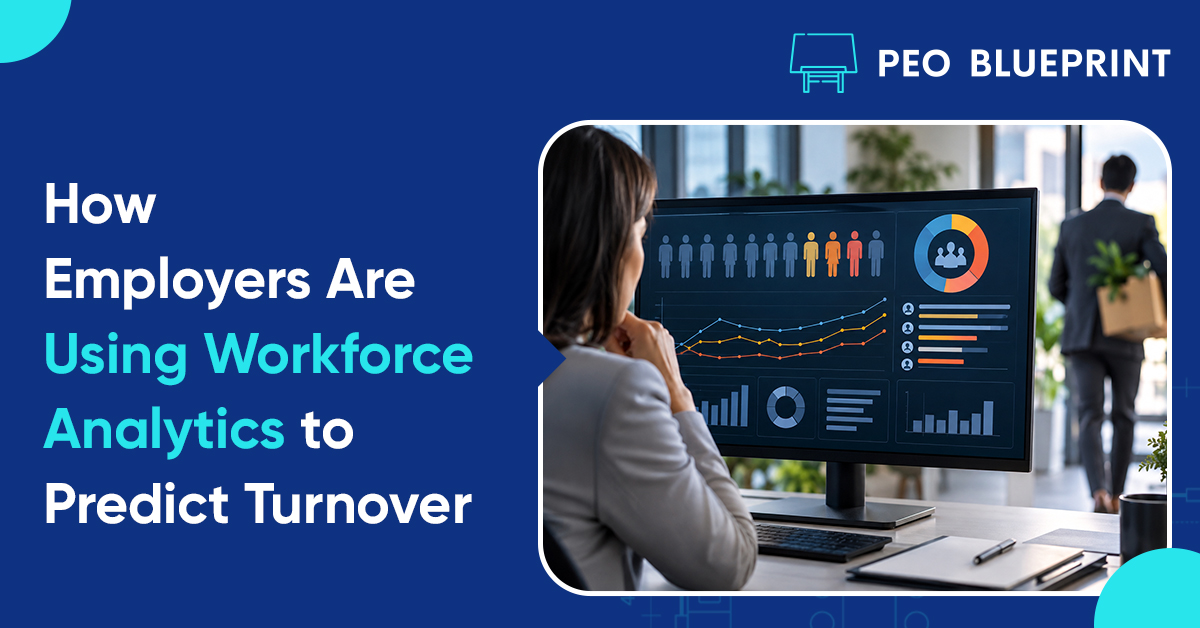
✔ Identify turnover risk before it escalates
✔ Analyze workforce productivity trends
✔ Detect compensation imbalances
✔ Evaluate hiring ROI
This analytical maturity allows HR leaders to speak the language of the CFO and CEO. Instead of reporting historical events, HR begins shaping future outcomes.
Strategic HR requires credible data. PEO Alignment provides the infrastructure to support it.
Accelerating Multi-State and Global Expansion
Growth often introduces regulatory complexity. Expanding into new states—or even international markets—demands mastery of employment laws, tax obligations, and compliance standards.
Organizations attempting expansion without operational readiness frequently encounter delays, penalties, or structural inefficiencies.
Through PEO Alignment, expansion becomes structured:
✔ State-level tax compliance managed
✔ Workers’ compensation coverage optimized
✔ Benefits adjusted to regional regulations
✔ Employment policies localized appropriately
This infrastructure allows companies to enter new markets with reduced friction. Instead of building compliance frameworks from scratch, they leverage established systems.
For high-growth companies, this acceleration can represent months of saved implementation time.
Repositioning HR as a Change Management Leader
Transformation inevitably involves change. Whether adopting new technologies, restructuring departments, or entering new markets, change management determines success.
Strategic HR plays a central role in:
✔ Communication planning
✔ Leadership alignment
✔ Employee transition support
✔ Cultural reinforcement
✔ Performance recalibration
When HR is overwhelmed with administrative tasks, change initiatives lose momentum.
PEO Alignment enables HR teams to focus on orchestrating structured change initiatives. This includes training programs, feedback loops, and performance integration strategies.
Organizations that embed HR within change leadership outperform those that treat change as a purely operational exercise.
Enhancing Risk Management Beyond Compliance
While compliance forms the foundation of risk management, strategic organizations expand the lens.
Comprehensive risk mitigation includes:
✔ Workplace safety programs
✔ Employment litigation prevention
✔ Ethical governance standards
✔ Workforce continuity planning
✔ Crisis response readiness
PEO Alignment strengthens these dimensions by offering structured advisory frameworks and industry best practices.
For example, during economic uncertainty, workforce restructuring decisions must be executed carefully to avoid legal exposure. With aligned guidance, companies navigate reductions or reorganizations with reduced risk.
Risk management shifts from defensive posture to strategic foresight.
The Talent Lifecycle Perspective
Strategic HR evaluates the entire employee lifecycle—from recruitment to exit—and optimizes each phase.
Through PEO Alignment, organizations can enhance:
Talent Acquisition
✔ Competitive compensation benchmarking
✔ Structured onboarding processes
✔ Regulatory-compliant hiring documentation
Employee Development
✔ Performance evaluation systems
✔ Skills tracking
✔ Leadership pathway mapping
Retention and Engagement
✔ Benefits optimization
✔ Engagement analytics
✔ Recognition frameworks
Offboarding and Knowledge Transfer
✔ Structured exit processes
✔ Compliance documentation
✔ Data protection controls
When each lifecycle stage operates cohesively, workforce stability improves.
Strategic HR does not treat employees as isolated transactions—it manages integrated journeys.
Financial Predictability and Budget Control
CFOs prioritize predictability. Volatile HR costs can disrupt financial planning.
PEO Alignment enhances cost transparency through:
✔ Consolidated service billing
✔ Predictable benefits pricing
✔ Standardized payroll processing
✔ Workers’ compensation management
Instead of navigating multiple vendor relationships with fluctuating expenses, organizations gain structured financial clarity.
Predictability strengthens capital allocation decisions and supports long-term planning.
Supporting Innovation Through Workforce Stability
Innovation thrives in stable environments.
When administrative disruptions, compliance issues, or payroll inconsistencies occur, employee morale declines and innovation stalls.
By stabilizing foundational HR processes, PEO Alignment creates conditions where teams can focus on product development, customer experience, and market strategy.
Innovation requires psychological safety, operational consistency, and leadership focus—all of which are reinforced through structured HR infrastructure.
HR Technology Adoption and Digital Transformation
Digital transformation initiatives often fail due to inadequate integration or insufficient training.
Within a PEO-aligned model, technology adoption benefits from:
✔ Pre-integrated systems
✔ Structured onboarding for digital platforms
✔ Ongoing system updates
✔ Secure data management
HR technology becomes an enabler rather than a burden.
Additionally, organizations gain Access to scalable digital tools without incurring excessive capital expenditures.
This modernization strengthens operational resilience.
Employer Branding and Market Perception
Top talent evaluates employers not only by salary but by stability, benefits, quality, and professional development opportunities.
PEO Alignment enhances employer branding by enabling:
✔ Competitive benefits packages
✔ Structured performance management
✔ Professional HR support
✔ Transparent policy frameworks
When employees experience well-organized, reliable HR systems, perceptions improve both internally and externally.
Employer branding becomes rooted in operational excellence rather than marketing alone.
Leadership Confidence and Strategic Clarity
Uncertainty in HR processes erodes executive confidence.
When payroll errors, compliance risks, or inconsistent policies emerge, leadership’s attention shifts away from growth strategy toward problem resolution.
PEO Alignment restores executive clarity by stabilizing HR infrastructure. This enables leadership to:
✔ Focus on strategic planning
✔ Pursue acquisition opportunities
✔ Allocate capital efficiently
✔ Enter new partnerships confidently
The psychological impact of reliable HR systems is significant. Leaders make bolder decisions when foundational systems are secure.
Integration with Mergers and Acquisitions
Mergers and acquisitions introduce complex HR integration challenges.
Key concerns include:
✔ Benefit harmonization
✔ Payroll system consolidation
✔ Cultural integration
✔ Regulatory compliance across entities
PEO Alignment simplifies post-merger transitions by providing structured systems that efficiently integrate new workforce segments.
This reduces disruption and accelerates the realization of synergies.
Building Organizational Agility
Agility is no longer optional.
Workforce models are evolving toward hybrid environments, project-based teams, and flexible employment structures.
PEO Alignment supports agility by:
✔ Streamlining onboarding for remote employees
✔ Managing multi-jurisdiction payroll
✔ Standardizing policies across locations
✔ Supporting flexible workforce structures
Agility requires infrastructure. Without it, rapid adaptation leads to compliance gaps and operational strain.
Aligned HR systems provide the foundation for responsive decision-making.
Strengthening Employee Trust Through Reliability
Trust is built through consistency.
Employees expect:
- Accurate payroll
- Clear benefits information
- Fair policies
- Timely communication
When these fundamentals are unstable, trust erodes quickly.
By stabilizing administrative functions, PEO Alignment enhances employee confidence in organizational leadership.
Trust, in turn, improves engagement, productivity, and retention.
The Role of HR Leadership in the Transformation Era
While external partnerships provide infrastructure, internal HR leadership remains critical.
Effective leaders within a PEO-aligned model must:
✔ Interpret workforce data strategically
✔ Communicate clearly with executives
✔ Champion cultural alignment
✔ Drive continuous improvement
✔ Monitor performance outcomes
PEO Alignment does not replace leadership—it amplifies it.
The most successful organizations view alignment as an enabler of leadership excellence rather than a substitute for it.
Continuous Improvement and Performance Optimization
Transformation is not a one-time initiative. It is an ongoing process.
Organizations should implement structured review cycles:
✔ Quarterly compliance reviews
✔ Annual benefits evaluations
✔ Workforce analytics assessments
✔ Employee satisfaction surveys
Continuous improvement ensures alignment evolves with organizational growth.
Strategic HR remains dynamic, adapting to market shifts and workforce expectations.
Economic Resilience and Downturn Preparedness
Economic volatility tests organizational strength.
During downturns, companies with strong HR infrastructure can:
✔ Implement cost-control measures responsibly
✔ Retain high-performing talent
✔ Maintain compliance despite restructuring
✔ Communicate transparently with employees
PEO Alignment supports structured workforce adjustments while mitigating legal and operational risk.
Resilience becomes a competitive advantage in times of uncertainty.
Future-Proofing the HR Function
The future of work continues to evolve rapidly. Automation, AI integration, skills-based hiring, and workforce mobility will redefine HR strategy.
Organizations prepared for this evolution share common characteristics:
✔ Data-driven decision-making
✔ Integrated HR systems
✔ Strategic leadership alignment
✔ Operational scalability
PEO Alignment positions companies to embrace emerging workforce models without destabilizing existing operations.
Future-proofing HR requires foundational strength today.
Strategic Synthesis: The Transformation Multiplier
When evaluating transformation initiatives, leadership must consider multiplier effects.
PEO Alignment does not operate in isolation. Its influence spans:
- Governance
- Finance
- Risk management
- Talent development
- Technology integration
- Organizational culture
This interconnected impact creates compounding strategic value.
Administrative HR ensures continuity. Strategic HR drives growth. Alignment bridges the two.
Measuring the Success of HR Transformation
Quantifiable metrics validate strategic shift:
✔ Revenue per employee
✔ Time-to-hire
✔ Voluntary turnover rates
✔ Employee engagement scores
✔ Compliance audit results
As these indicators improve, the business case for PEO Alignment strengthens.
Final Thoughts: Building a Strategic HR Engine
Transitioning from administrative HR to strategic HR is not optional—it is imperative for sustainable growth.
PEO Alignment acts as the catalyst.
By redistributing operational tasks, enhancing compliance resilience, strengthening benefits competitiveness, and enabling data-driven insights, organizations reposition HR as a growth driver.
Strategic HR influences:
- Business expansion
- Workforce productivity
- Leadership effectiveness
- Cultural cohesion
- Risk mitigation
In today’s competitive environment, the companies that align their HR infrastructure with strategic intent will outperform those that treat HR as a back-office necessity.
The journey requires commitment, governance, and thoughtful partnership. But the outcome is transformative: a resilient, scalable, future-ready organization where human capital strategy directly fuels business success.